
Amides are derivatives of carboxylic acids, therefore, one strategy to convert aldehydes to amides is by first oxidizing them to carboxylic acids. Once we have the carboxylic acid, we can subject it to condensation with amines using a coupling agent such as DCC or EDC. Alternatively, we can convert the carboxylic acid to acid chloride, which are the most reactive carboxylic acid derivatives, and readily reacts with all types of nucleophiles, including amines:
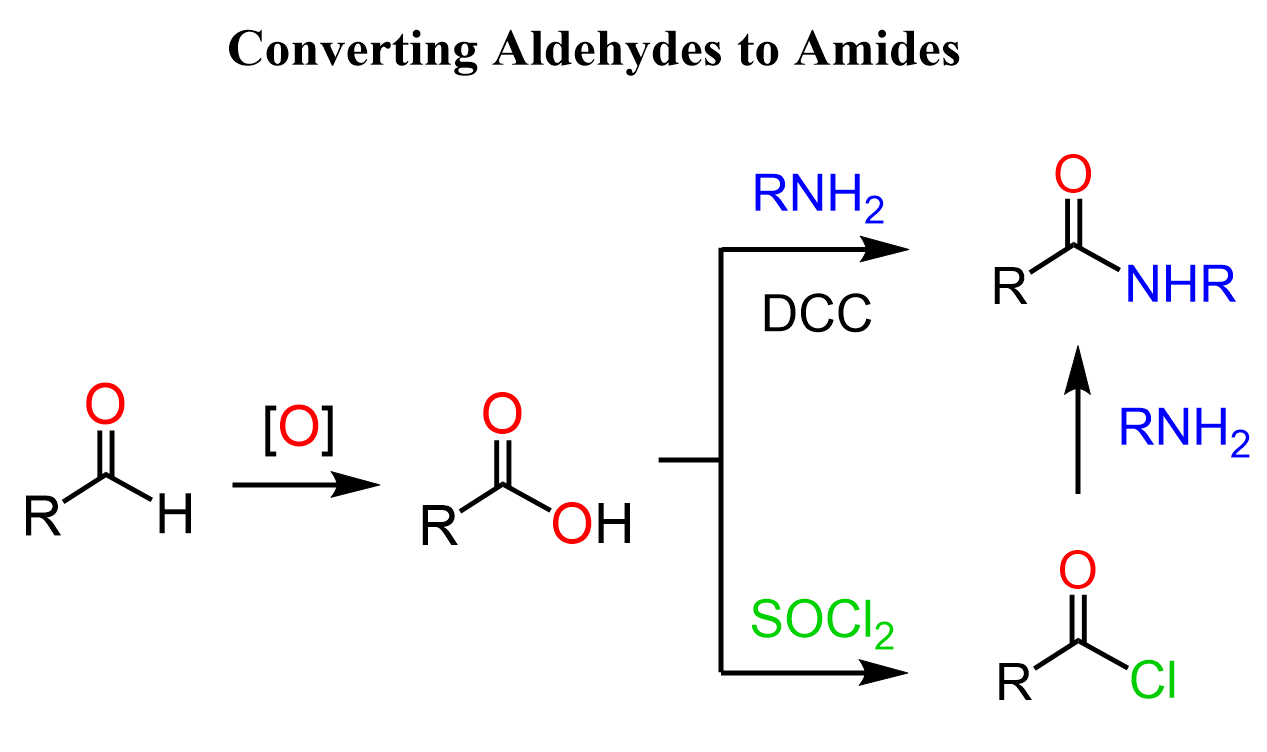
Aldehydes to Amides via Oxidative Cleavage
If the conversion of the aldehyde to amide shortens the carbon chain, then the process may involve some oxidative cleavage of a π bond. For example, we can convert the aldehyde to an alkene, cleave the double bond, forming a carboxylic acid, and then convert the latter to an amide:
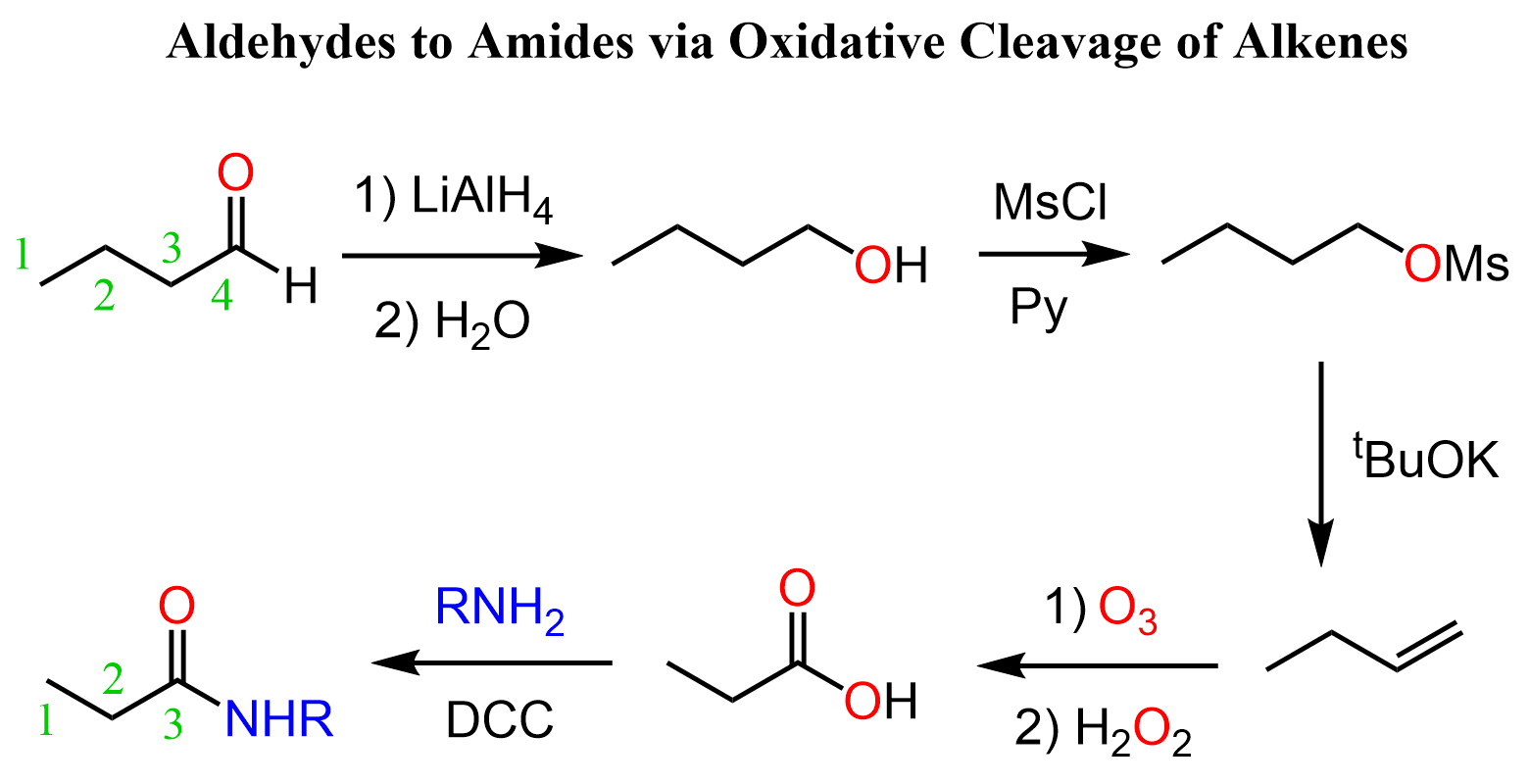
We first convert the aldehyde to an alkene via a reduction and either Zaitsev or Hofmann elimination, and oxidize the alkene to a carboxylic acid by either ozonolysis or KMnO4. Once we have the carboxylic acid, we can condensate it with an amine using a coupling reagent or by converting it to an acid chloride first.

Organic Chemistry Reaction Maps
Never struggle again to figure out how to convert an alkyl halide to an alcohol, an alkene to an alkyne, a nitrile to a ketone, a ketone to an aldehyde, and more! The comprehensive powerfull Reaction Maps of organic functional group transformations are here!
Check Also
- Nomenclature of Aldehydes and Ketones
- How to Name a Compound with Multiple Functional Groups
- Preparation of Aldehydes and Ketones
- Nucleophilic Addition to Carbonyl Groups
- The Addition-Elimination Mechanism
- Reduction of Carbonyl Compounds by Hydride Ion
- Reactions of Aldehydes and Ketones with Water
- Reactions of Aldehydes and Ketones with Alcohols: Acetals and Hemiacetals
- Acetals as Protecting Groups for Aldehydes and Ketones
- Imines from Aldehydes and Ketones with Primary Amines
- Enamines from Aldehydes and Ketones with Secondary Amines
- Reactions of Aldehydes and Ketones with Amines-Practice Problems
- Acetal Hydrolysis Mechanism
- Imine and Enamine Hydrolysis Mechanism
- Reaction of Aldehydes and Ketones with CN Cyanohydrin Formation
- Hydrolysis of Acetals, Imines, and Enamines-Practice Problems
- The Wittig Reaction: Examples and Mechanism
- The Wittig Reaction-Practice Problems
- Aldehydes and Ketones Reactions Practice Quiz