
The Kiliani–Fischer synthesis lengthens the carbon chain of carbohydrates by adding one carbon to the aldehyde group of an aldose.
For example, using this method, D-arabinose can be converted into a mixture of D-glucose and D-mannose:
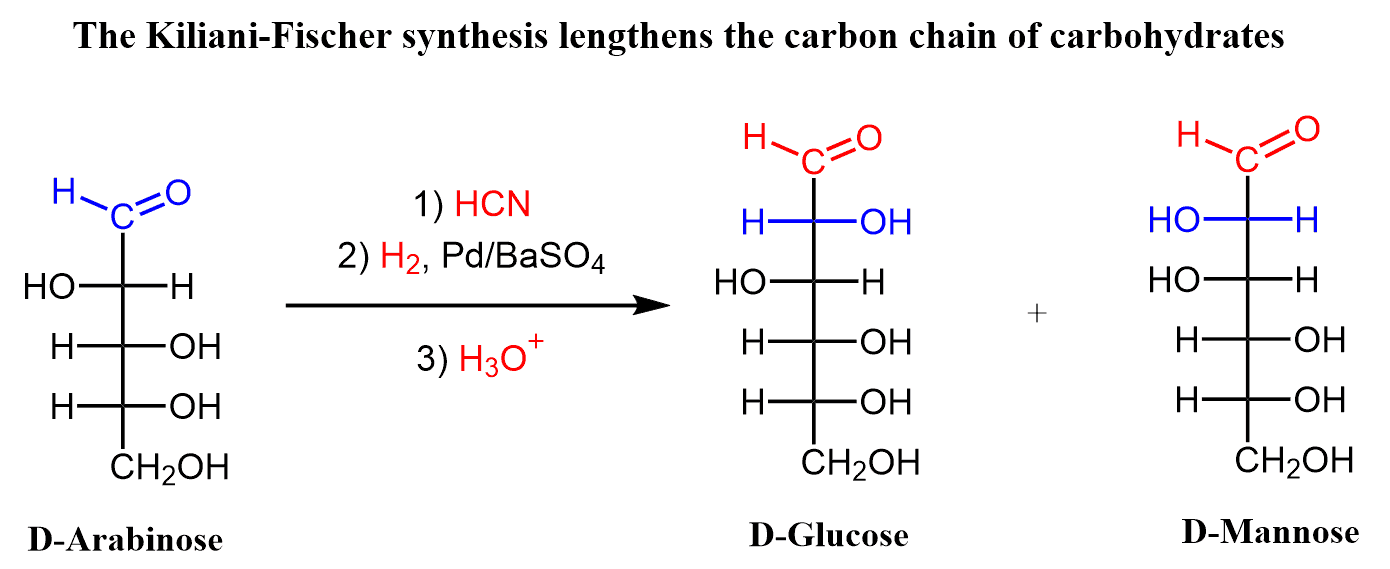
Notice that two epimers are formed as a product since they only differ at the new stereogenic center at C2.
So, let’s now understand the mechanism behind the formation of these epimers. In the first part of the Kiliani–Fischer synthesis, we have an addition reaction of the cyanide to the aldehyde, forming a cyanohydrin. This is when a new carbon is added to the carbohydrate chain:

Remember, we have seen this quite often in the synthesis of carboxylic acids and their derivatives. The nitrile group is a good electrophile that can further be reacted with a variety of nucleophiles such as Grignard or Organocuprate nucleophiles.
Now, in this particular synthesis, the nitrile group is reduced to an imine using H2 and a Pd-BaSO4 catalyst, and in the last step, we only need to convert the imine to an aldehyde by acidic hydrolysis:
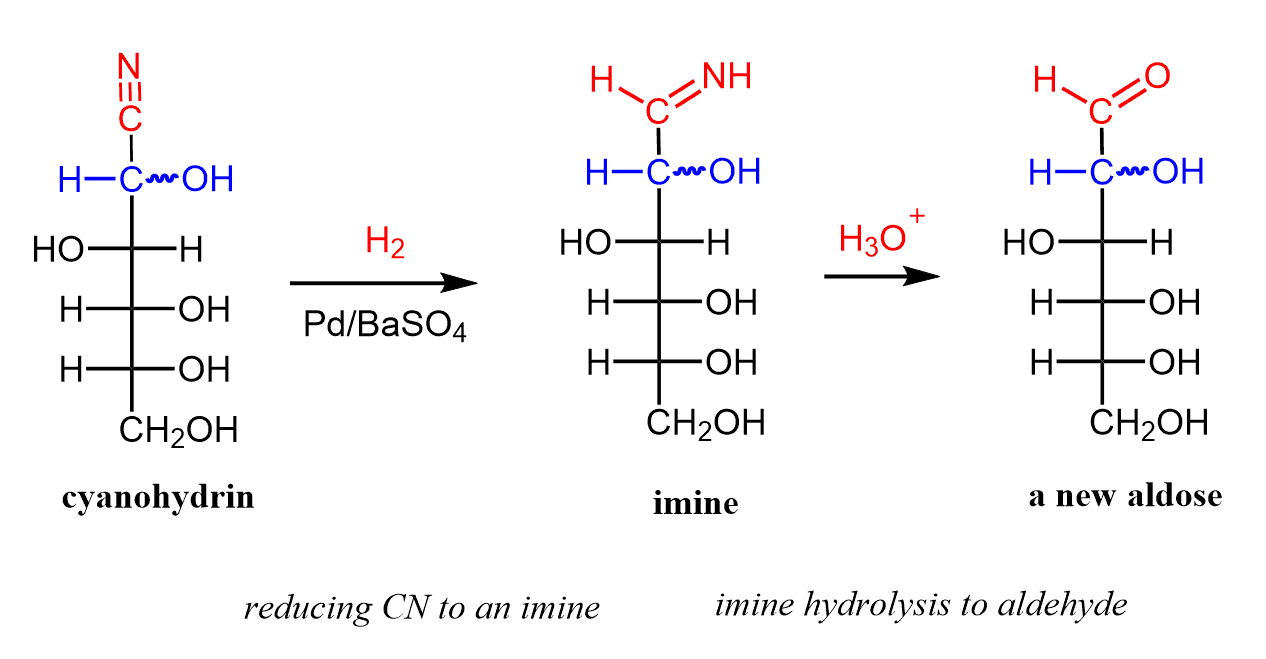
Let’s put these steps into a little summary of the Kiliani–Fischer synthesis, which increases the carbohydrate chain of an aldose by one carbon atom:

How to Shorten Carbohydrates
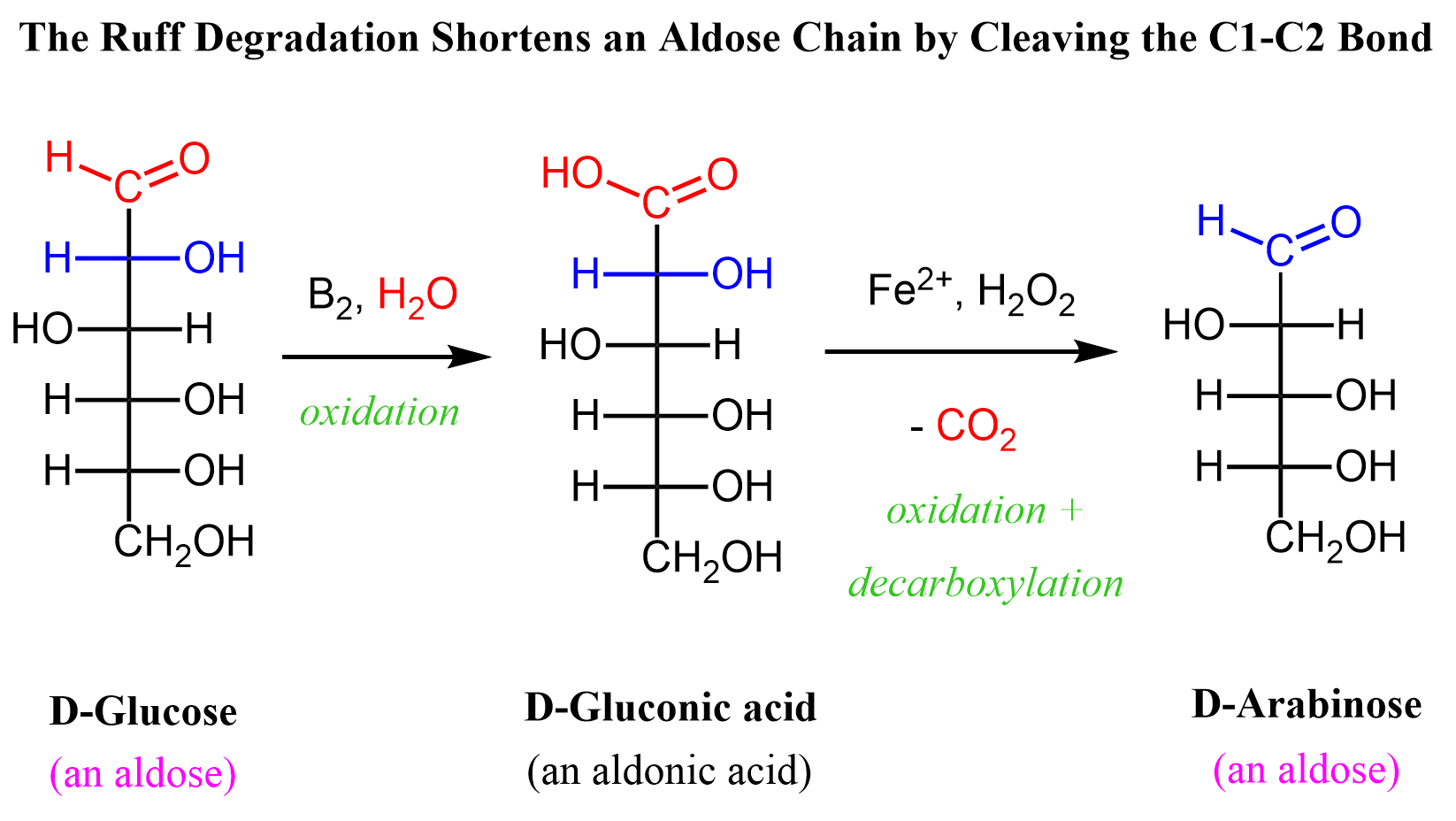
It is possible to perform the reverse reaction of the Kiliani-Fischer synthesis; that is, we can also shorten the length of the carbon chain of carbohydrates. There are two main approaches for this that you may need to know: 1) The Ruff degradation and 2) The Wohl degradation.
In the Ruff degradation, the carbon chain of the carbohydrate is shortened by oxidation of the aldehyde group to a carboxylic acid, followed by decarboxylation, which removes one carbon atom as CO2:
In the Wohl degradation, the shortening is achieved by converting the aldehyde group into a nitrile and then removing it as HCN.
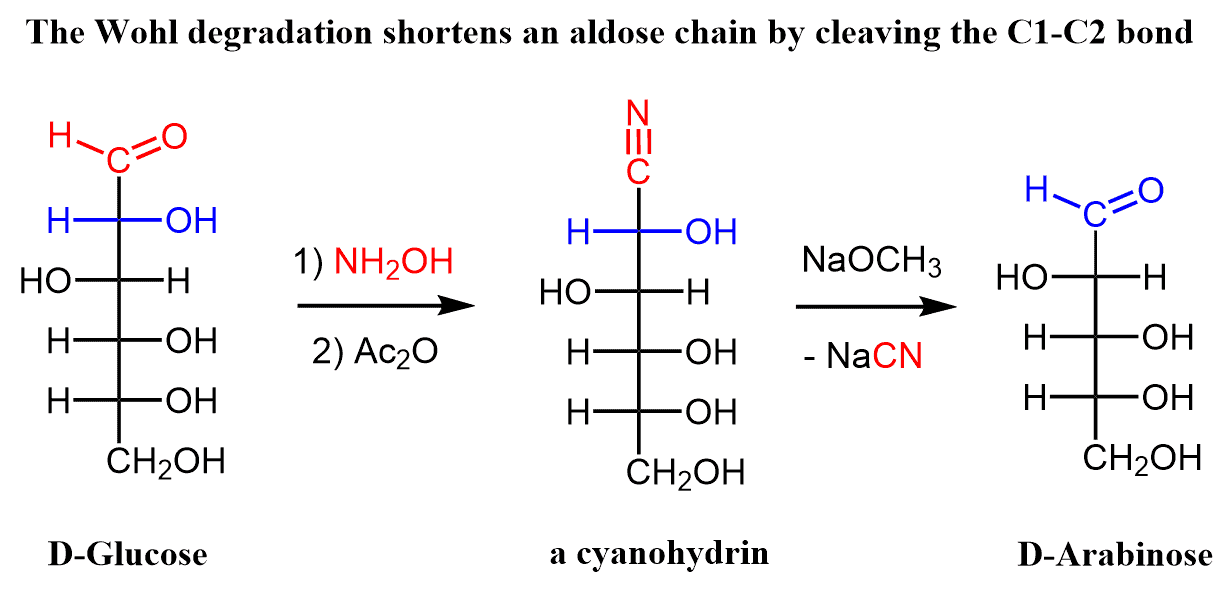
Check the linked articles for both reactions for more details about their mechanisms.
Need some practice on carbohydrates?
Check this Multiple-Choice, summary quiz on the structure and reactions of carbohydrates with a 40-min video solution!

Carbohydrates Practice Problem Quiz
Check Also
- Carbohydrates – Structure and Classification
- Erythro and Threo
- D and L Sugars
- Aldoses and Ketoses: Classification and Stereochemistry
- Epimers and Anomers
- Converting Fischer, Haworth, and Chair forms of Carbohydrates
- Mutarotation
- Glycosides
- Isomerization of Carbohydrates
- Ether and Ester Derivatives of Carbohydrates
- Oxidation of Monosaccharides
- Reduction of Monosaccharides
- Kiliani–Fischer Synthesis
- Wohl Degradation
This is so helpful.
Thanks indeed
Thanks, Anthony.