
In the previous post, we talked about the nucleophilic aromatic substitution, looking at the specifics of the mechanism, regiochemistry, and the limitations.
Below are some additional examples to practice these concepts.
In the previous post, we talked about the nucleophilic aromatic substitution, looking at the specifics of the mechanism, regiochemistry, and the limitations.
Below are some additional examples to practice these concepts.
Determine the product in each nucleophilic aromatic substitution reaction.

This content is for registered users only.
By joining Chemistry Steps, you will gain instant access to the answers and solutions for all the Practice Problems, including over 40 hours of problem-solving videos, Multiple-Choice Quizzes, Puzzles, Reaction Maps, and the powerful set of Organic Chemistry 1 and 2 Summary Study Guides.
Suggest a synthesis of acetaminophen, also known as Tylenol, from benzene:

This content is for registered users only.
By joining Chemistry Steps, you will gain instant access to the answers and solutions for all the Practice Problems, including over 40 hours of problem-solving videos, Multiple-Choice Quizzes, Puzzles, Reaction Maps, and the powerful set of Organic Chemistry 1 and 2 Summary Study Guides.
Draw a possible mechanism for each synthetic transformation:

This content is for registered users only.
By joining Chemistry Steps, you will gain instant access to the answers and solutions for all the Practice Problems, including over 40 hours of problem-solving videos, Multiple-Choice Quizzes, Puzzles, Reaction Maps, and the powerful set of Organic Chemistry 1 and 2 Summary Study Guides.
Identify the missing products and reagents in the following synthetic scheme which includes electrophilic aromatic substitution, nucleophilic aromatic substitution, epoxides, and Diels-Alder reaction:
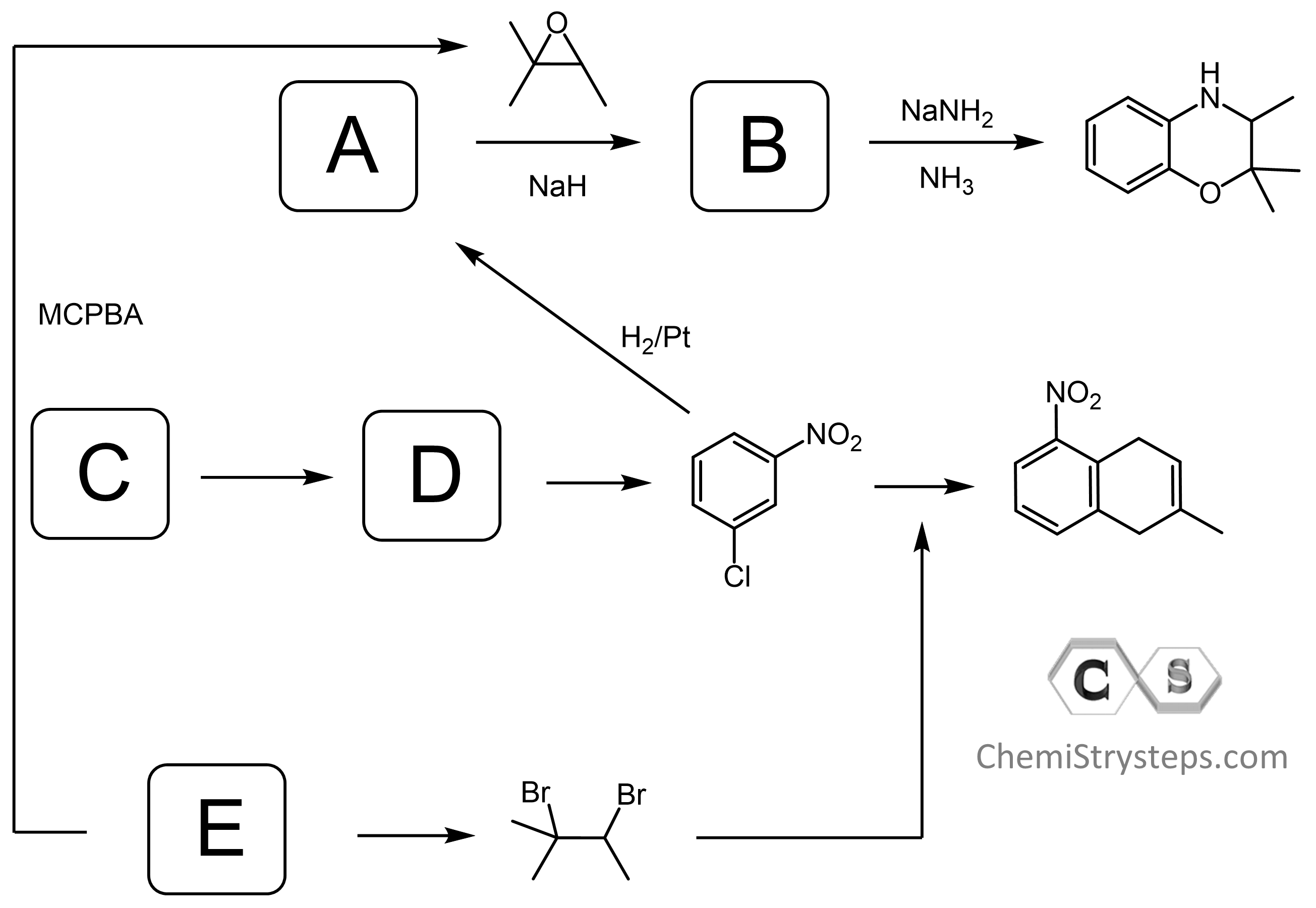
This content is for registered users only.
By joining Chemistry Steps, you will gain instant access to the answers and solutions for all the Practice Problems, including over 40 hours of problem-solving videos, Multiple-Choice Quizzes, Puzzles, Reaction Maps, and the powerful set of Organic Chemistry 1 and 2 Summary Study Guides.
When the following phenoxide is reacted with 4-Nitrochlorobenzene, the expected product A of nucleophilic aromatic substitution is not formed. Instead, an isomer of compound A is formed. Identify the structures of both A and B and explain why only B is formed:

This content is for registered users only.
By joining Chemistry Steps, you will gain instant access to the answers and solutions for all the Practice Problems, including over 40 hours of problem-solving videos, Multiple-Choice Quizzes, Puzzles, Reaction Maps, and the powerful set of Organic Chemistry 1 and 2 Summary Study Guides.
Draw the mechanism and identify the missing compounds in the following synthetic scheme:

This content is for registered users only.
By joining Chemistry Steps, you will gain instant access to the answers and solutions for all the Practice Problems, including over 40 hours of problem-solving videos, Multiple-Choice Quizzes, Puzzles, Reaction Maps, and the powerful set of Organic Chemistry 1 and 2 Summary Study Guides.
Explain the formation of two isomers in the following SNAr by drawing the corresponding mechanisms:

This content is for registered users only.
By joining Chemistry Steps, you will gain instant access to the answers and solutions for all the Practice Problems, including over 40 hours of problem-solving videos, Multiple-Choice Quizzes, Puzzles, Reaction Maps, and the powerful set of Organic Chemistry 1 and 2 Summary Study Guides.
Draw a plausible mechanism for the following 3 + 2 (3 atoms + 2 atoms) cycloaddition (recall the Diels-Alder reaction) reaction that goes via in situ benzyne formation.

Hint: recall that fluoride has a high affinity for silicon
This content is for registered users only.
By joining Chemistry Steps, you will gain instant access to the answers and solutions for all the Practice Problems, including over 40 hours of problem-solving videos, Multiple-Choice Quizzes, Puzzles, Reaction Maps, and the powerful set of Organic Chemistry 1 and 2 Summary Study Guides.
Check Also
It’s really nice. Very helpful
Thanks a lot
For number 1e, how do we get an ethoxide and not an alcohol?
A typo – thanks for pointing that out.
Comparing benzyne formation in Q3b and Q4. The substrate is same but the benzyne and the final products are very different. Please explain. Thanks
That is a good question. The key here is the regiochemistry of the benzyne (aryne, more generally) formation. When the EWG and the halogen are meta-oriented, there are two possibilities for where the triple bond can form. And it turns out that the hydrogen ortho to the EWG is more acidic and is removed by the base. This is due to the stabilizing effect of the EWG:
You can also read about this in March’s Advanced Organic Chemistry, 7th ed., p. 778.
With that said, the major regioisomer in 3B should be like it is in 4.