
Alcohols can be oxidized into a variety of carbonyl compounds depending on the nature of the alcohol and the oxidizing agent used.
Secondary alcohols can only be oxidized to ketones, while primary alcohols are oxidized to aldehydes and carboxylic acids, depending on whether a mild or strong oxidizing agent is used.
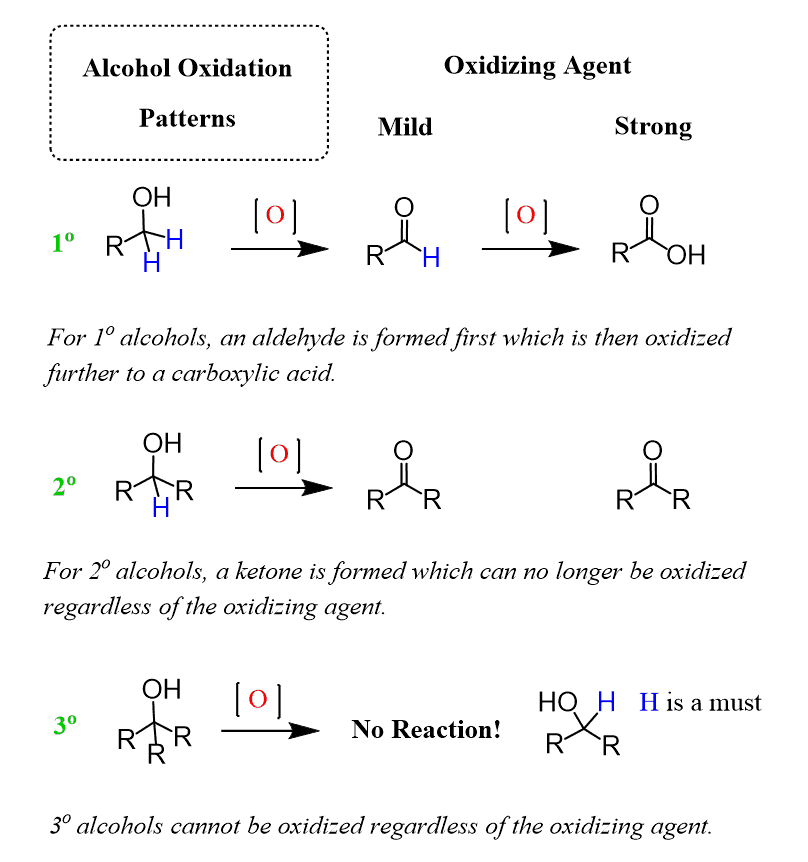
As shown above, mild reagents stop the oxidation once the carbonyl group is formed. And if it is a primary alcohol, the product is an aldehyde, while the oxidation of a secondary alcohol results in a ketone.
Although very often the outcome of the oxidation will depend on the presence or absence of water, traditionally, the most common mild oxidizing agents are considered pyridinium chlorochromate (PCC), pyridinium dichromate (PDC), Swern oxidation using DMSO, (COCl)2, and Et3N, and the Dess-Martin (DMP) oxidation:

Notice that the oxidation of secondary alcohols produces ketones regardless of what oxidizing agent is used. We will get this later when discussing the mechanisms of alcohol oxidation reactions.
The strong oxidizing agents oxidize Primary Alcohols to Carboxylic Acids and Secondary Alcohols to Ketones.
These are the most common strong oxidizing agents you will need to know:

Chromic acid (H2CrO4) is formed either from chromium trioxide (CrO3) or from sodium dichromate (Na2Cr2O7) in the presence of sulfuric acid. This is also known as the Jones reagent.
Potassium permanganate (KMnO4) is usually used in a basic aqueous solution and nitric acid. Both oxidize primary alcohols to carboxylic acids and secondary alcohols to ketones. One thing to keep in mind when using them is the possible overoxidation, which may cleave carbon–carbon bonds if the temperature and concentrations are not precisely controlled.
Sodium hypochlorite (NaClO), which is the household bleach, is a good alternative to the above-mentioned strong oxidizing agents, which can be used to achieve the same oxidation without the need to use harsh conditions and create hazardous waste.
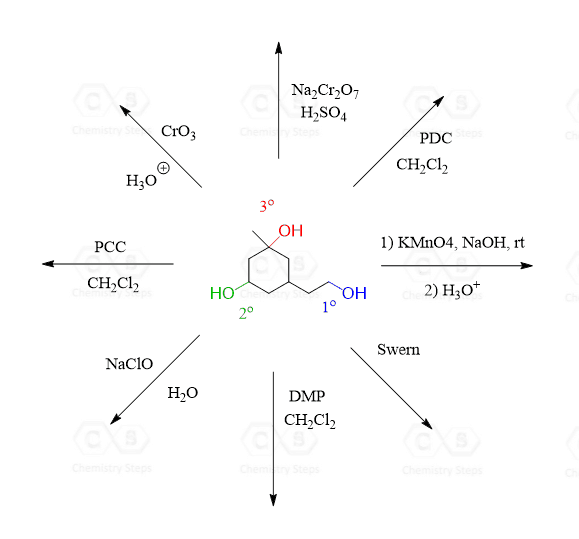
This may seem too much to remember, so I put together a little summary of alcohol oxidation reagents:
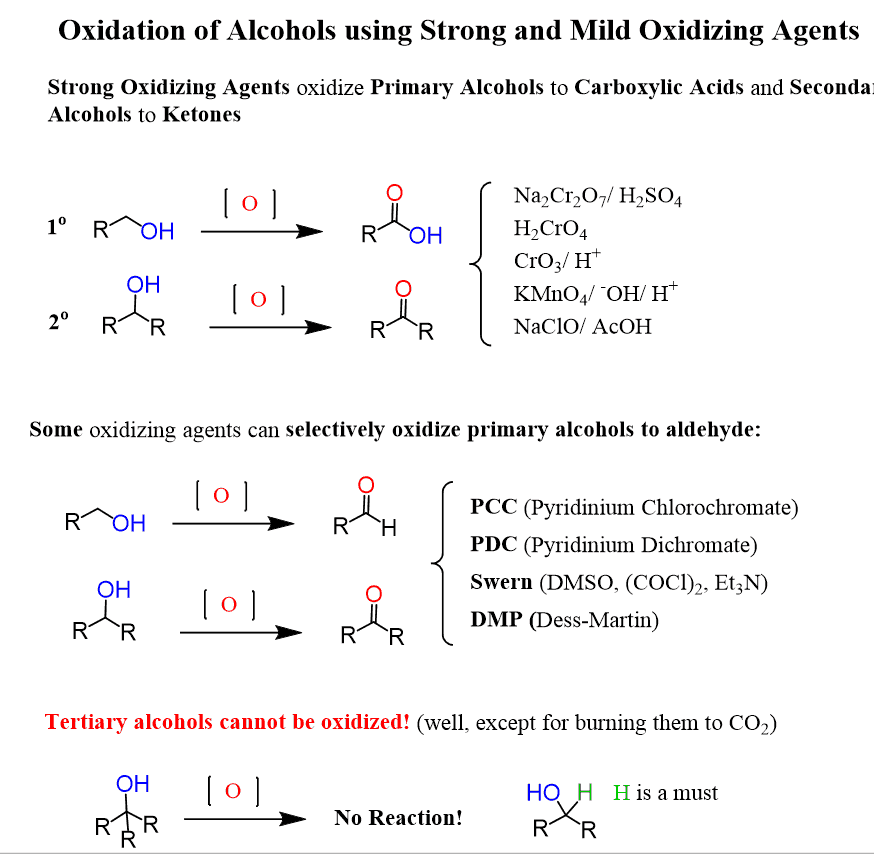
Notice that tertiary alcohols cannot be oxidized regardless if we use a strong or mild oxidizing agent, and we will see the reason for this when discussing the mechanisms of alcohol oxidations below.
Alcohol Oxidation Mechanisms
There are quite a few reagents used for the oxidation of alcohols, but the good news is that most of them follow a similar mechanism, and we will try to identify a common trend for these reactions.
The idea here is to install a leaving group on the hydroxyl oxygen and remove the neighboring hydrogen by kicking out the leaving group to form a c=O π bond. It should remind you of the E2 mechanism:
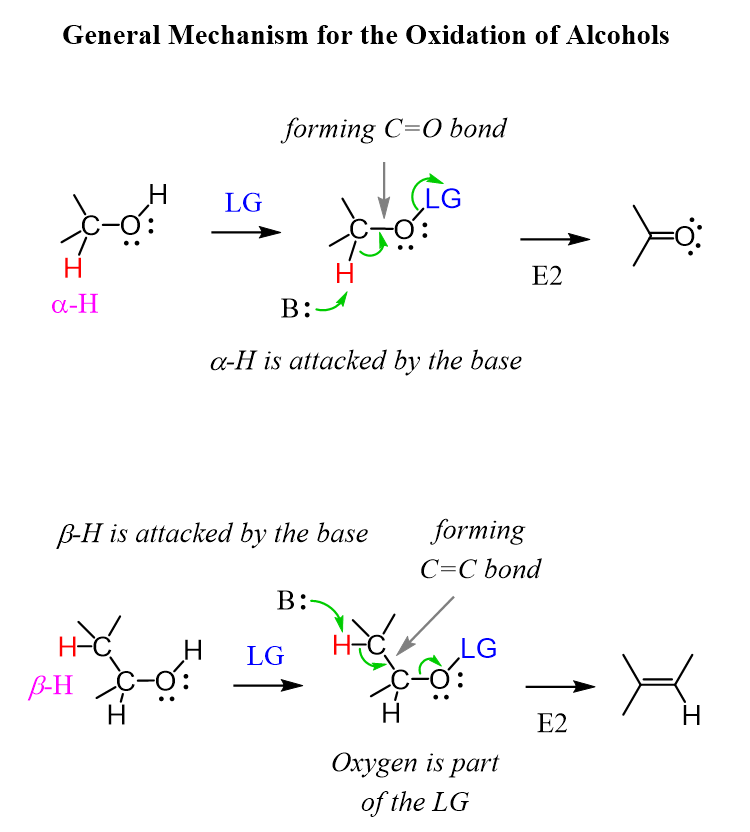
Notice the importance of the ɑ-hydrogen in the elimination step. It is the removal of this hydrogen that provides the electrons to form the C=O π bond, and because tertiary alcohols do not contain an ɑ-hydrogen, they do not undergo elimination reactions:
This shows the formation of a ketone or an aldehyde, but what about the carboxylic acids?
Remember, we have said earlier that strong oxidizing agents oxidize alcohols to carboxylic acids. So, this process goes through the formation of the corresponding aldehyde, which is then further oxidized to a carboxylic acid:
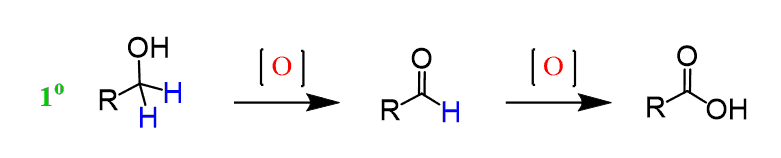
Now, there is one good question you might be wondering: how come the aldehyde is oxidized to a carboxylic acid if it does not contain a hydroxyl group to react as shown above:

And the answer to this is that aldehydes react with water, forming an aldehyde hydrate, which resembles the structure of secondary alcohols in that it contains the necessary hydroxyl group and the hydrogen to be eliminated:
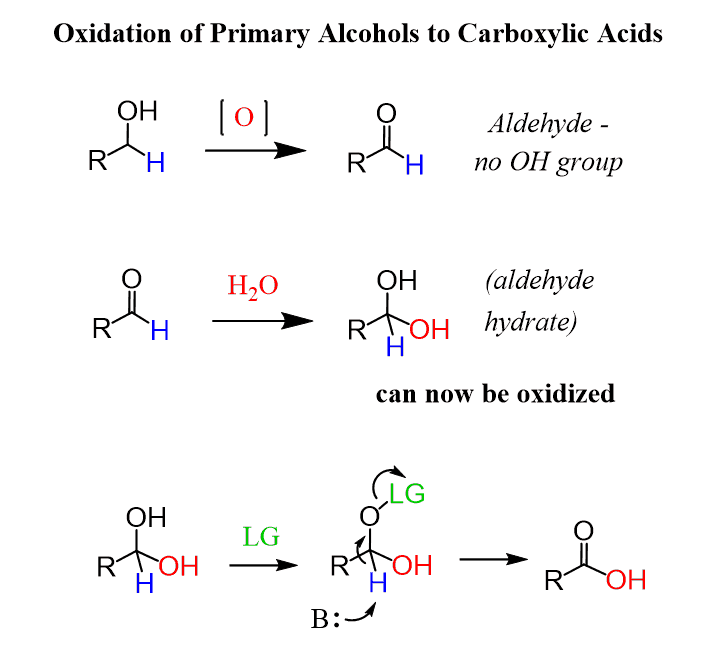
This is also the secret to the mild oxidizing agents, which are used in the absence of water, which allows stopping the oxidation once the aldehyde is formed. So, it is not the “oxidizing power” of the reagent that makes it strong or weak, but rather the reaction conditions, and specifically the presence of water, which transforms the aldehyde into a hydrate, which essentially is an alcohol with an extra OH group and therefore, when oxidized, a carboxylic acid is formed.
Let’s now discuss the specific oxidation reactions and their mechanisms based on this general feature, starting with the mild oxidizing agents.
Pyridinium Chlorochromate (PCC) Oxidation
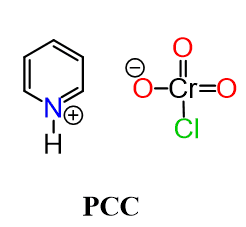 This is a Cr6+ salt formed between pyridine (C6H5N), HCl, and CrO3. It is soluble in halogenated organic solvents such as dichloromethane, which allows carrying out the reaction in the absence of water.
The reaction starts by converting the alcohol to its corresponding chromate ester, which then undergoes a deprotonation by a base to form a C=O double bond:
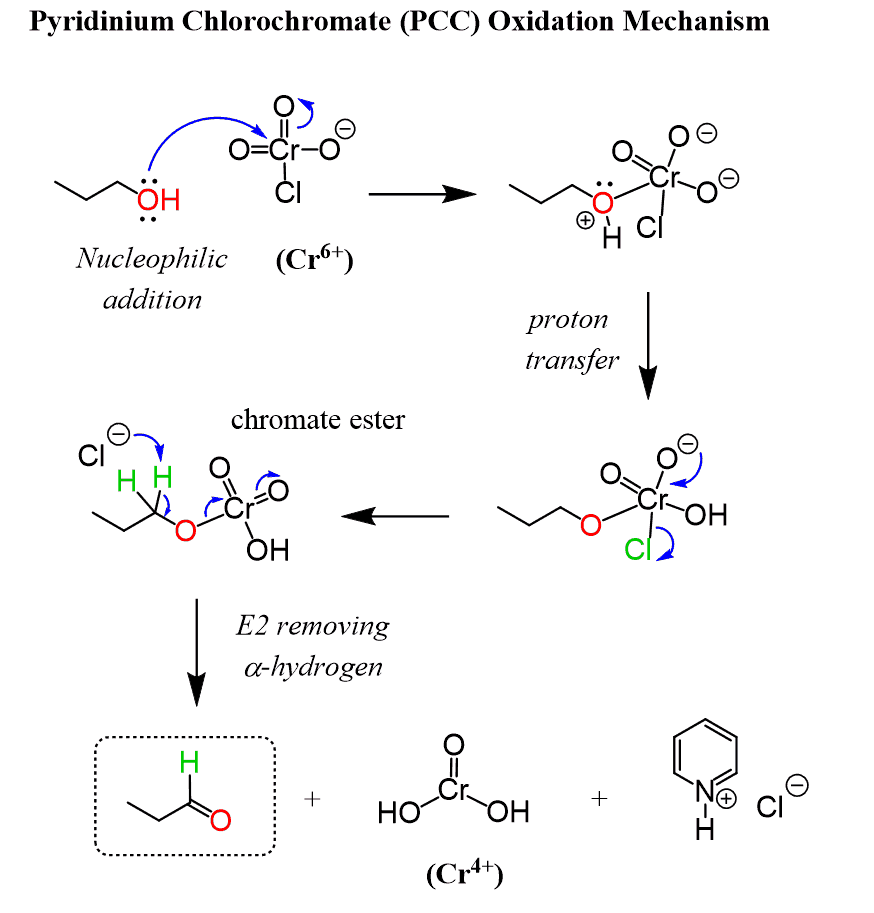
In the acid-base step, either the chloride ion or the alcohol can serve as a base to remove the hydrogen. Pyridine is certainly a better candidate for a deprotonation; however, it is present in a low concentration as a free base in acidic conditions.
So far, all our attention was on the organic substrate, but remember, this is an oxidation-reduction reaction, and while the alcohol is being oxidized to a carbonyl, the Cr6+ is reduced to the corresponding Cr4+ species.
Swern Oxidation
 As mentioned earlier, chromium-based oxidations have disadvantages mainly because of the associated hazardous waste. Therefore, a group of alternative oxidation techniques has been developed over the years to support green chemistry.
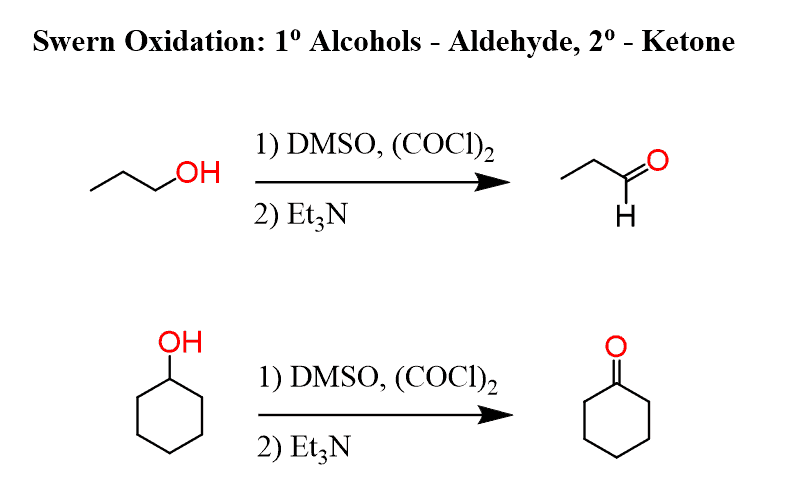
Two of these are the Swern oxidation and the Dess–Martin oxidation, which, just like the PCC and PDC, are used to convert primary alcohols to aldehydes and secondary alcohols to ketones.
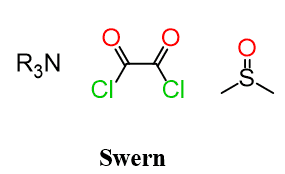
Dimethyl sulfoxide (DMSO) and oxalyl chloride (COCl)2 are used as oxidizing agents in the Swern oxidation:
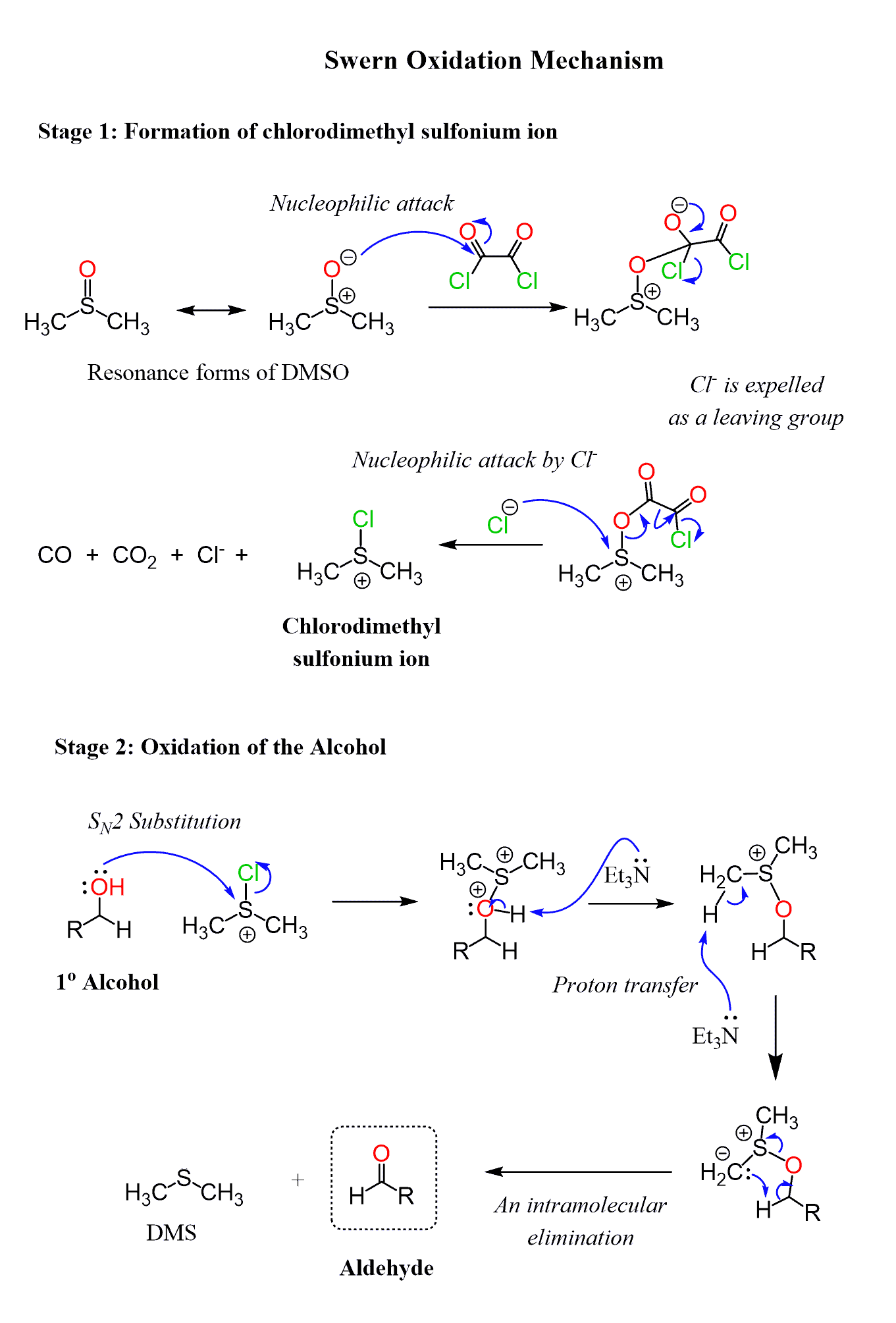
In the first step, DMSO and oxalyl chloride react to form a chlorodimethylsulfonium salt, which is a Lewis acid, and reacts with the alcohol, thus installing the good leaving group necessary for the elimination step:
Dess–Martin periodinane (DMP) oxidation
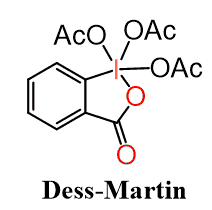
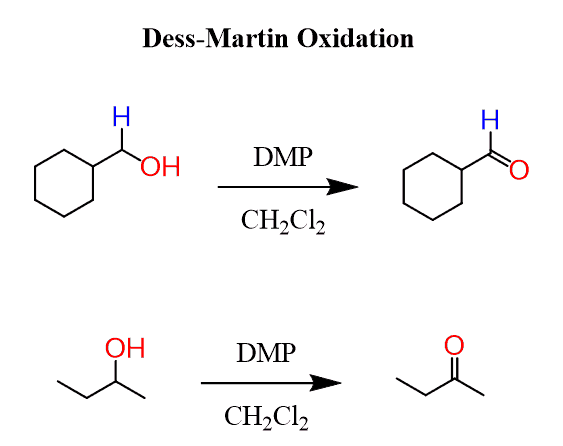
Another important reagent for the selective oxidation of primary alcohols to aldehydes is the Dess–Martin periodinane (DMP oxidation).
It is performed at milder conditions and does not require the presence of strong acids at high temperatures:
The reaction starts with a substitution on the iodine, where the alcohol replaces one of the acetate ions, which then serves as a base to deprotonate the oxygen, forming the periodinane intermediate:
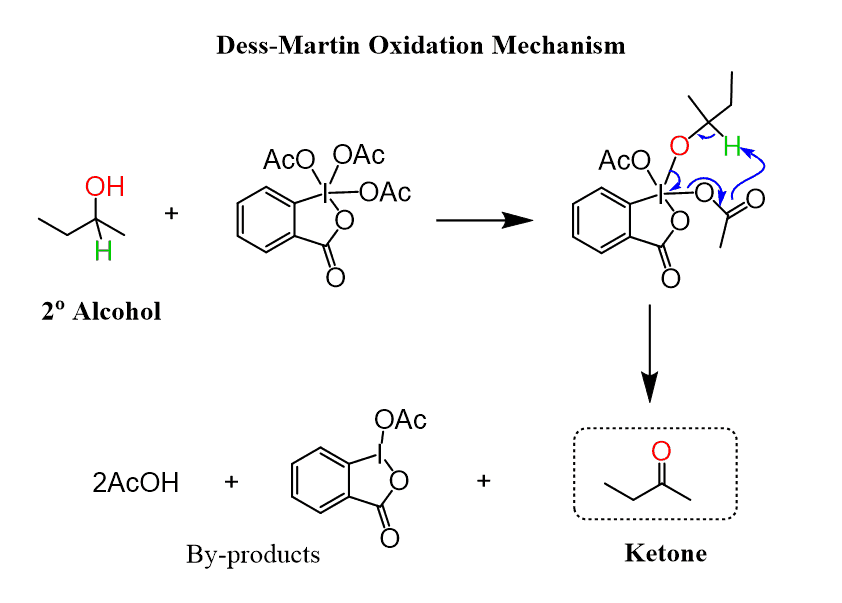
The periodinane intermediate is then transformed to the corresponding carbonyl compound by a possible intramolecular removal of the ɑ-hydrogen to form a C=O π bond.
Let’s now go over the strong oxidizing agents, which oxidize primary alcohols to carboxylic acids and secondary alcohols to ketones.
Oxidation of an Alcohol with Chromic Acid, H2CrO4 – Jones oxidation
Aqueous acidic solutions of sodium dichromate (Na2Cr2O7) or chromium trioxide (CrO3) are used to form chromic acid (H2CrO4), which oxidizes primary alcohols to carboxylic acids and secondary alcohols to ketones.
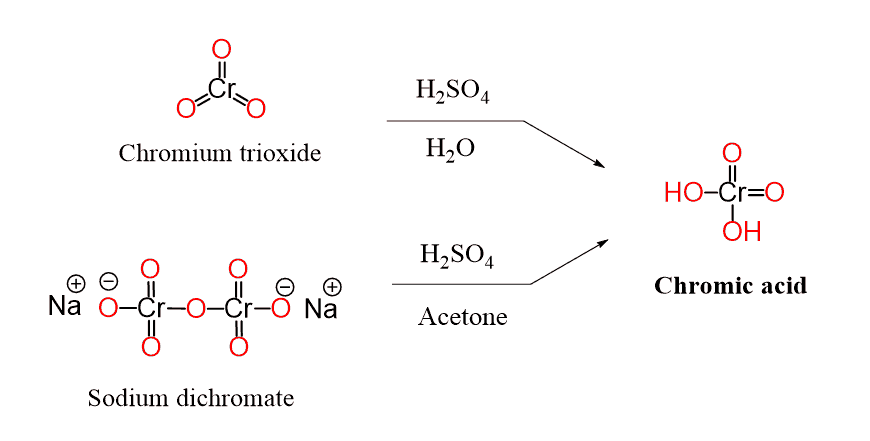
These are all known as the Jones reagent, which is a strong oxidizing agent that converts primary alcohols to carboxylic acids and secondary alcohols to ketones.
The alcohol reacts with the chromic acid, forming a chromate ester where the CrO3– is now a good leaving group. This allows for the removal of the ɑ-hydrogen to form a C=O π bond by an E2 mechanism.
The aldehyde is further oxidized to a carboxylic acid in a similar way once the aldehyde reacts with water to form a hydrate that contains the necessary ɑ-hydrogen:
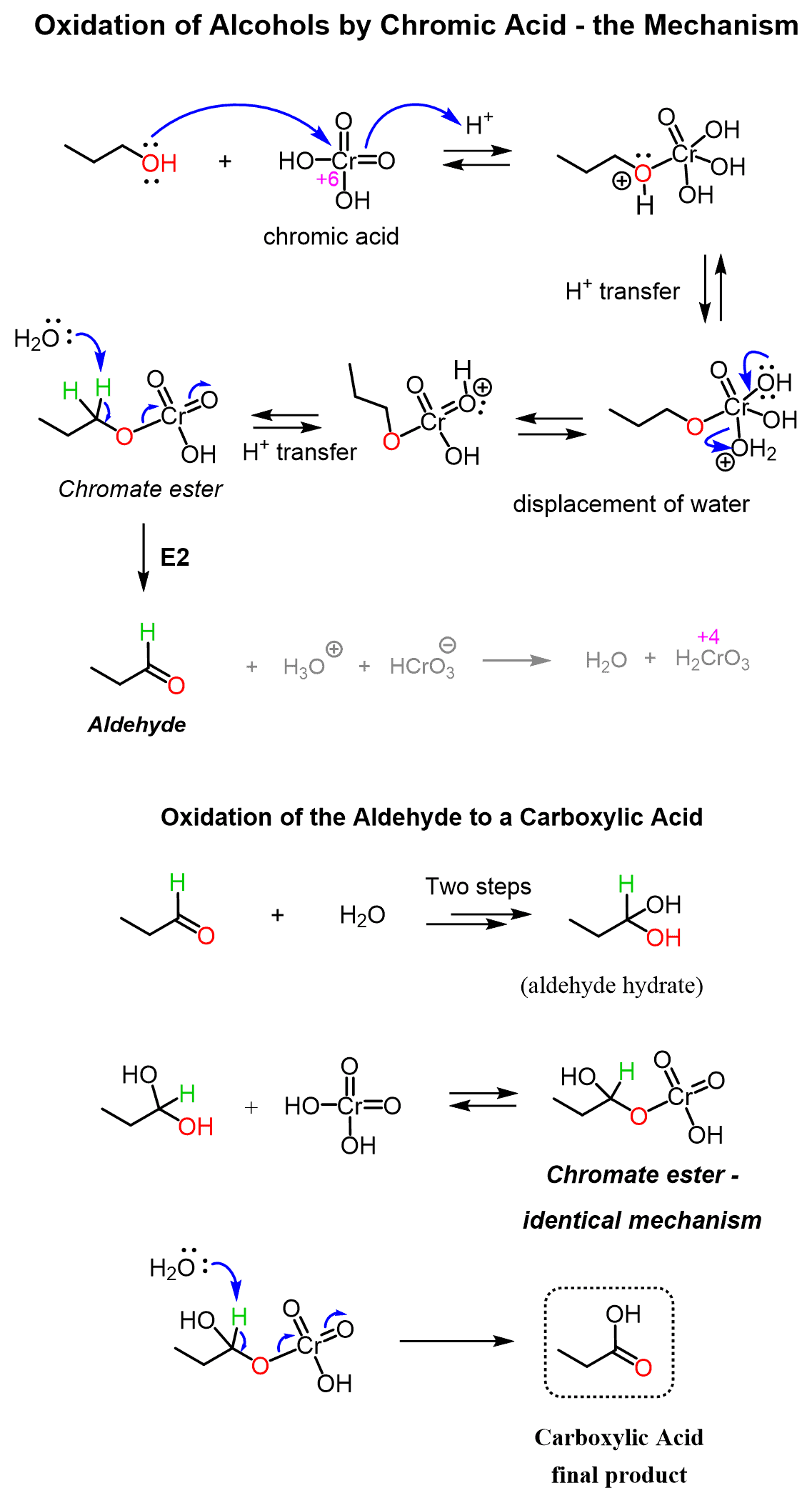
Notice that this “overoxidation” to a carboxylic acid does not occur when mild oxidizing agents are used since there is no water present to convert the aldehyde to a hydrate, which is capable of undergoing another oxidation.
Oxidation of Alcohols with Sodium Hypochlorite (HClO)
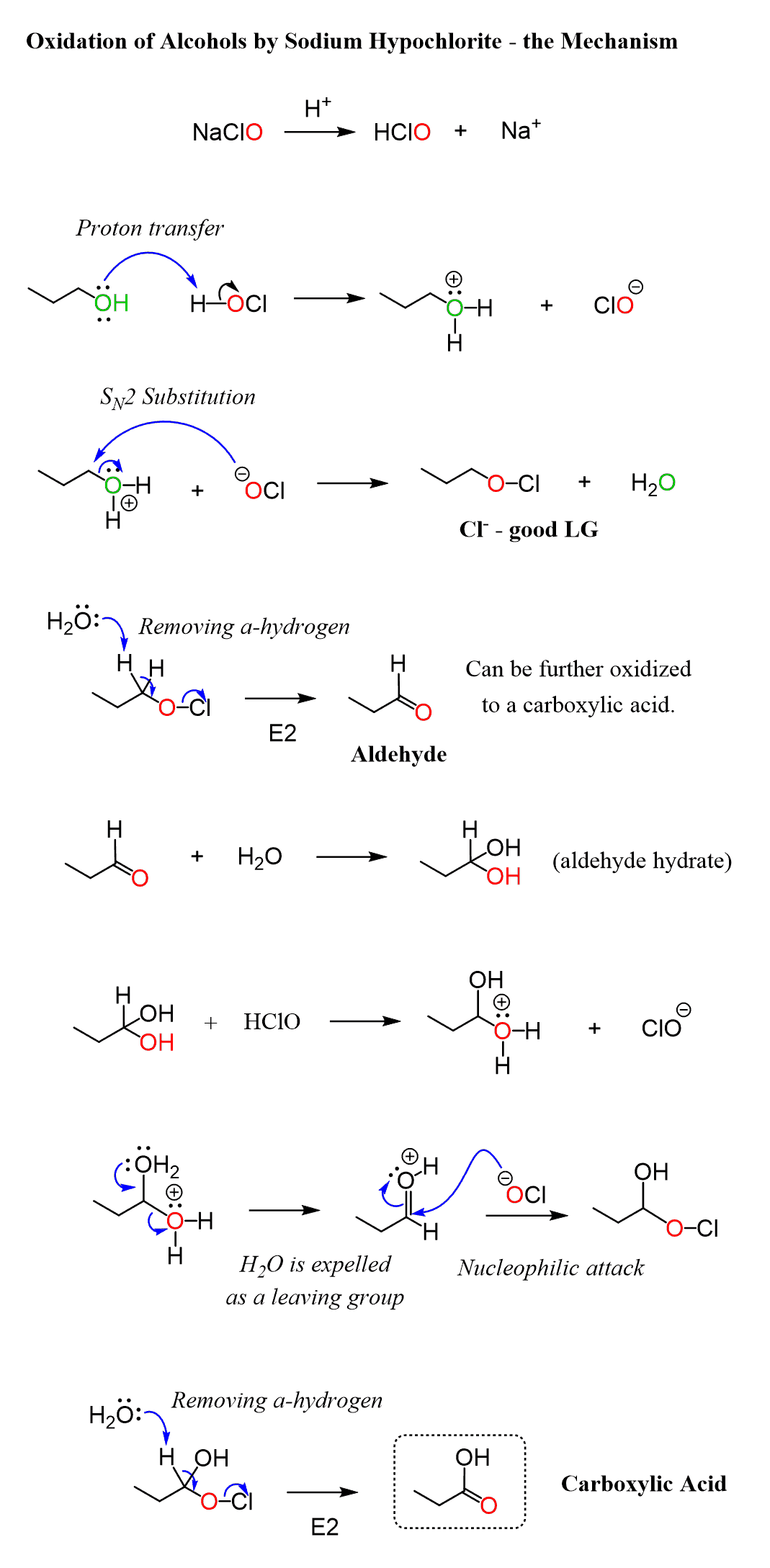
Sodium Hypochlorite (NaClO) is another alternative to the chromium-based oxidations and can be used for the oxidation of primary and secondary alcohols.
It follows the same theme of elimination mechanisms by adding a good leaving group to the oxygen and performing an E2 elimination. The good leaving group here is the chloride ion:
Oxidation of Alcohols with Potassium Permanganate (KMnO4)
Much like the chromium-based oxidations, potassium permanganate oxidizes primary alcohols to carboxylic acids and secondary alcohols to ketones.
There are arguments about the mechanism of this oxidation; however, it is plausible and widely accepted by many instructors if you show a mechanism involving an E2 elimination, just like we have been doing for the other oxidation reactions.
Reaction of the alcohol with KMnO4 sets up a good leaving group in the form of HMnO4, which promotes the E2 reaction with the hydroxide ion:

HMnO4 reacts with water to form a brown precipitate, MnO2, which gives a colorimetric indication of the extent to which the alcohol is oxidized.
The reaction also requires an acidic workup since the carboxylic acid is deprotonated under the basic conditions. Therefore, in summary, it can be shown as:
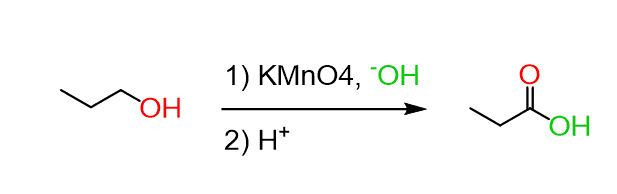
Summarizing the Oxidation of Alcohols
The oxidation of alcohols is an important transformation in organic chemistry, as different carbonyl functional groups can be formed depending on the alcohol’s structure and the oxidizing agent.
-
Primary alcohols can be oxidized to aldehydes or further to carboxylic acids, depending on the reagent and conditions.
-
Secondary alcohols are oxidized to ketones only.
-
Tertiary alcohols do not oxidize because they lack the necessary α-hydrogen.
The key distinction between mild and strong oxidizing agents is not just about their inherent strength but whether the reaction is done in the presence of water, which allows aldehydes to form hydrates that can be further oxidized to acids.
-
Mild oxidizers (e.g., PCC, PDC, DMP, Swern) stop at aldehydes.
-
Strong oxidizers (e.g., Jones reagent, KMnO₄, NaClO) take primary alcohols all the way to carboxylic acids.
Mechanistically, alcohol oxidations often follow an E2-like elimination, where a leaving group is installed on the oxygen and the α-hydrogen is removed to form the C=O π bond. This shared mechanism helps demystify the various reagents used across different conditions.
love it!
So much needed information 👍
The permanganate and chromic acid oxidations of the primary alcohols is confusing because an oxygen disappears in the second step, but reappears later in the mechanism.
I see. The formation of chromate ester is a few steps process and does look confusing when shown at once. I have added the missing steps.
This is a gem… Thank you so much!
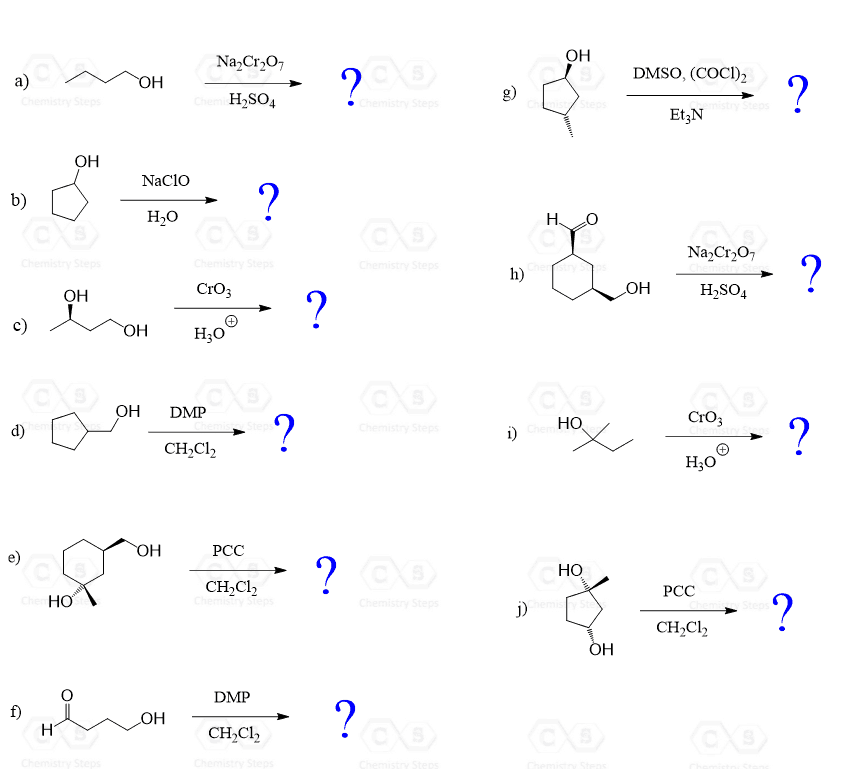
In the item h,
Why it is formed carboxylic not aldehyde?