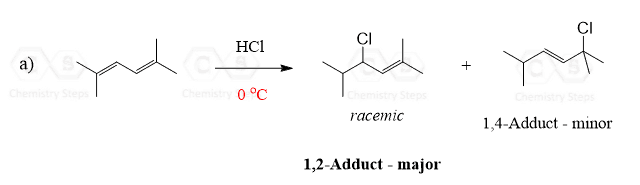
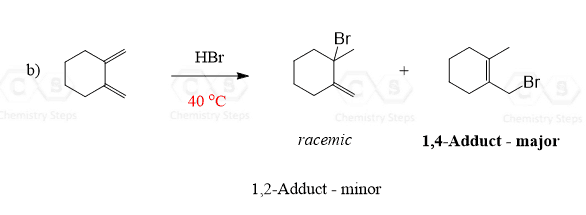
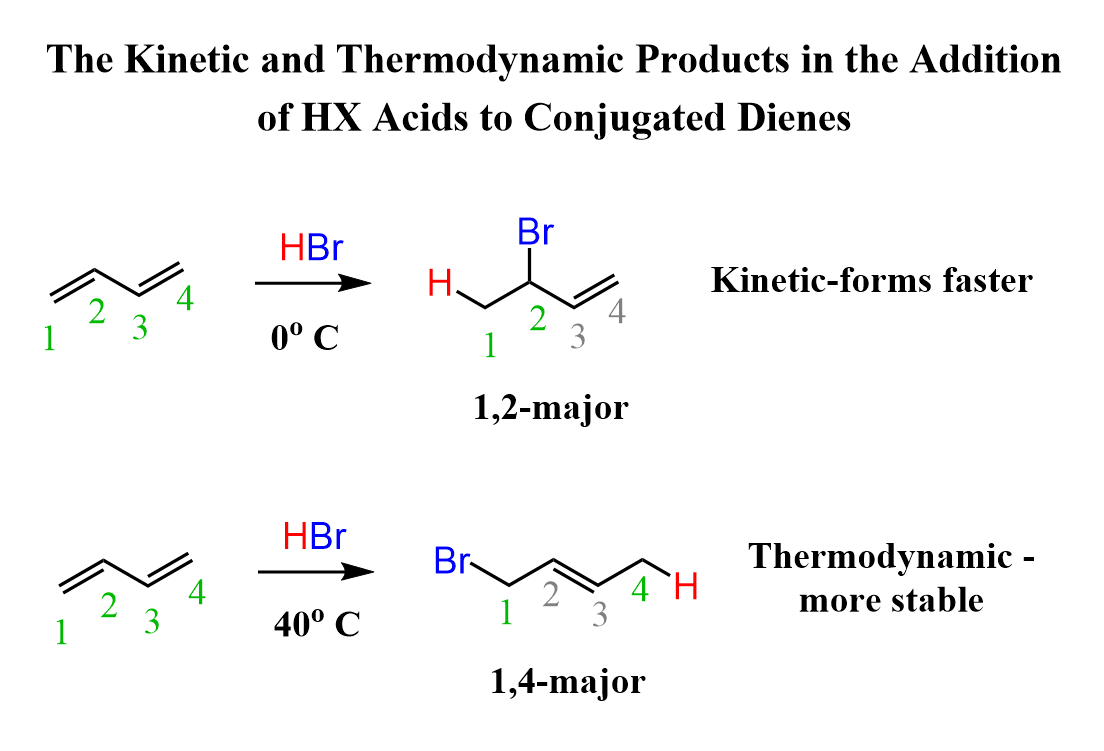
Electrophilic addition to a conjugated diene can give two regioisomeric products. For example, the addition of HBr to 1,3-butadiene gives a mixture of 3-bromobut-1-ene and 1-bromobut-2-ene:
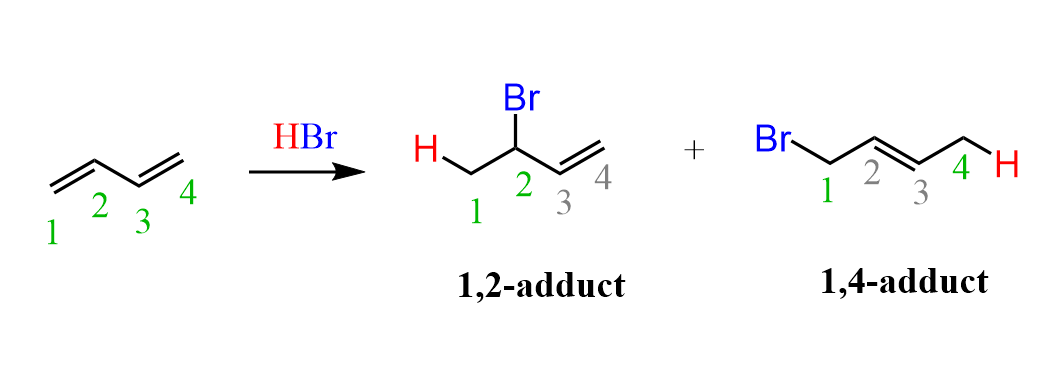
The products of these reactions are always formed as a mixture, but the good news is that we can change the reaction conditions to favor the formation of one or the other isomer. This is achieved mainly by changing the temperature of the reaction.
It turns out that if the reaction is carried out at 0 °C or below, the 1,2-addition product, 3-bromobut-1-ene, is formed in greater amounts. On the other hand, if we heat the reaction to 40 °C, the 1,4-addition product, 1-bromobut-2-ene, is formed in greater amounts:
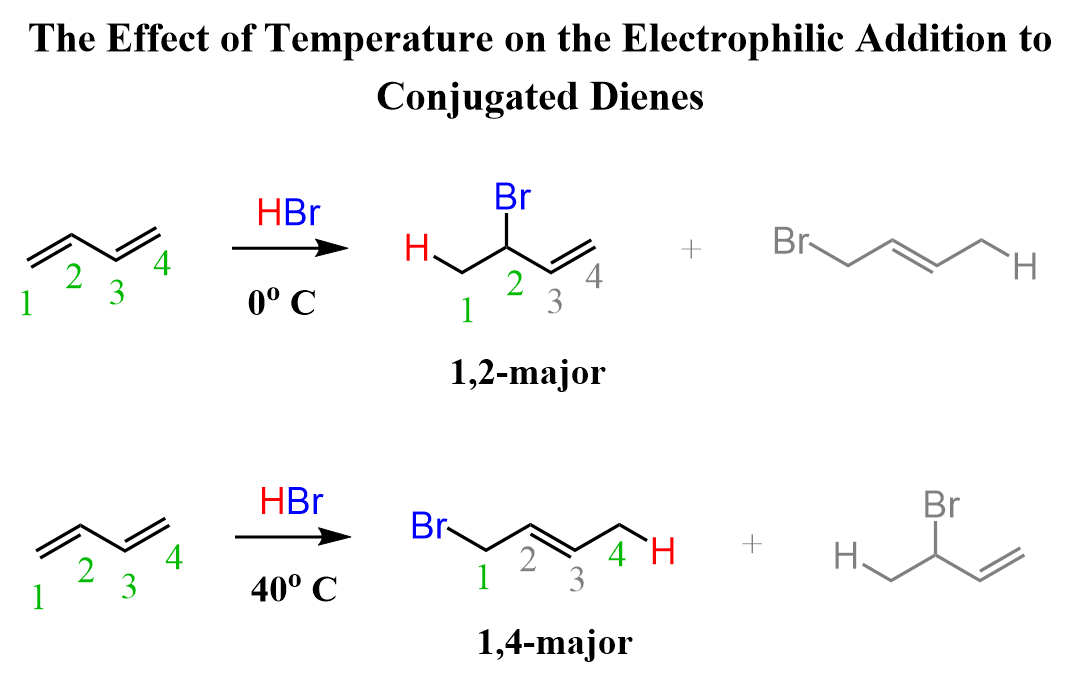
These are called kinetic and thermodynamic products, respectively. In simple terms, kinetic means fast, so the kinetic product is the product that forms faster, through the pathway with the lower activation energy.
On the other hand, the thermodynamic product is the more stable product. It may not form as quickly, but it is more stable than the kinetic product.
Now, the 1,2-adduct has a monosubstituted alkene, while the 1,4-adduct has a disubstituted alkene. Since the disubstituted alkene is more stable, the 1,4-adduct is the thermodynamic product:
So, the question is why and how the thermodynamic product is formed if it has a higher activation. For this, we need to take a look at the mechanism of the reaction.
Under both conditions, the mechanism of the reaction is the same. It starts with protonation of the diene, which gives a resonance-stabilized allylic carbocation:
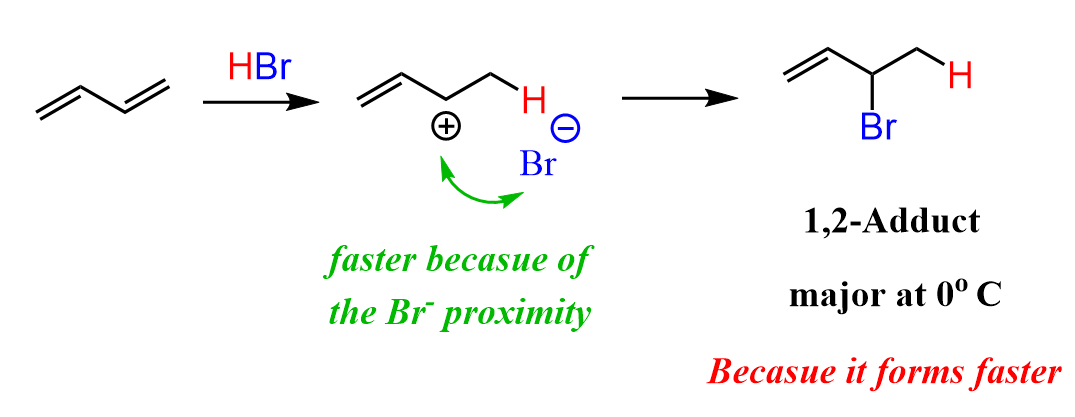
Notice that the Br⁻ ion is in close proximity to the positively charged carbon, and it can attack this carbon quickly. This gives the 1,2-addition product, which is the kinetic product.
Now at higher temperatures, this still occurs, but the key difference is that the reaction becomes reversible, and part of the kinetic product breaks back to the allylic carbocation. The Br⁻ then gets another chance to attack either of the carbon atoms, and it does both. But since the 1,4-adduct is more stable, less of it breaks back, while the 1,2-adduct, being less stable, breaks back more readily. This happens until the majority of the product that has accumulated is the more stable isomer:
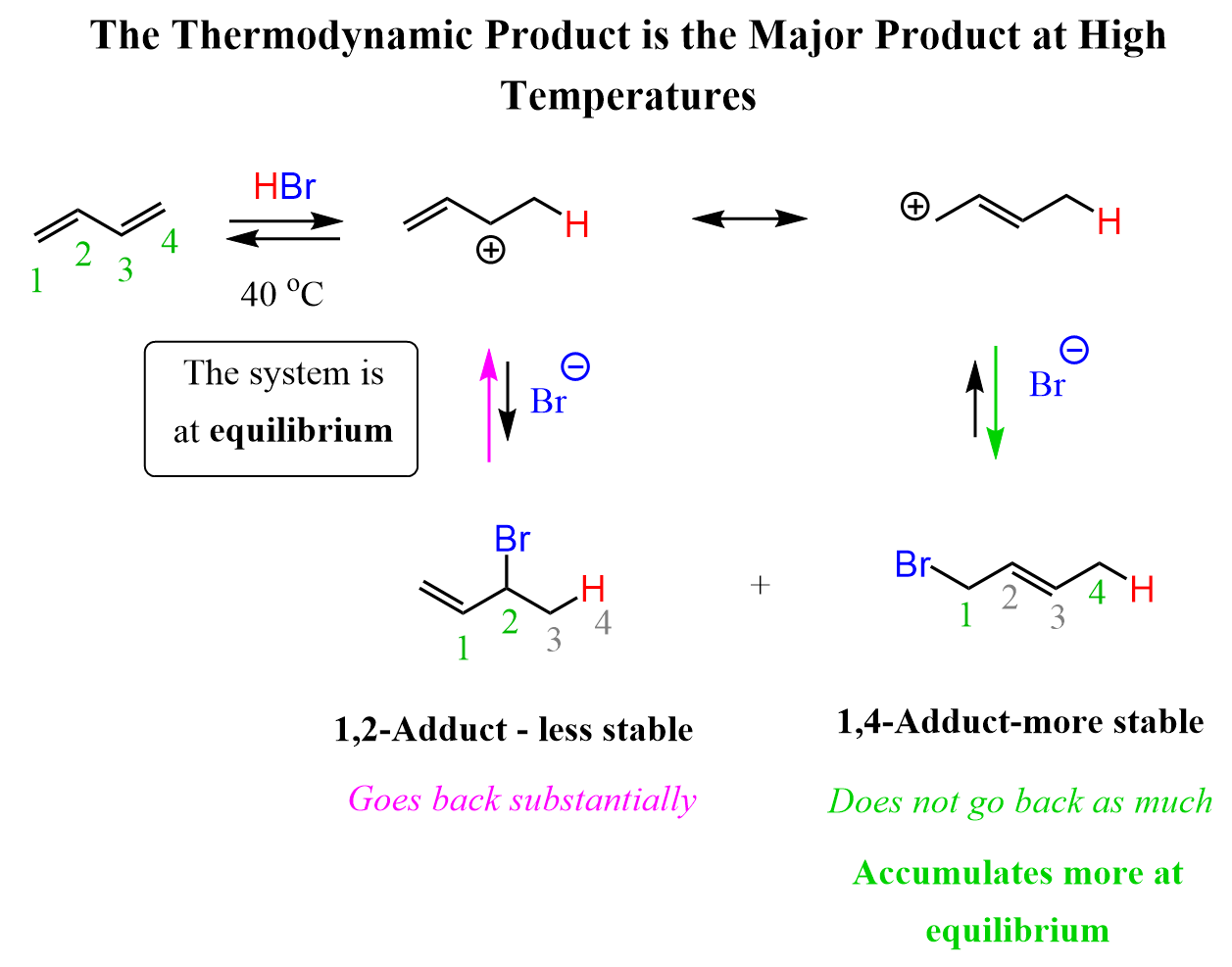
For this to happen, the molecules need enough energy for the reverse reaction to occur at an appreciable rate, and this is why a higher temperature is needed. If we kept the reaction at a lower temperature, not much of the 1,2-product would dissociate back to form the more stable product:
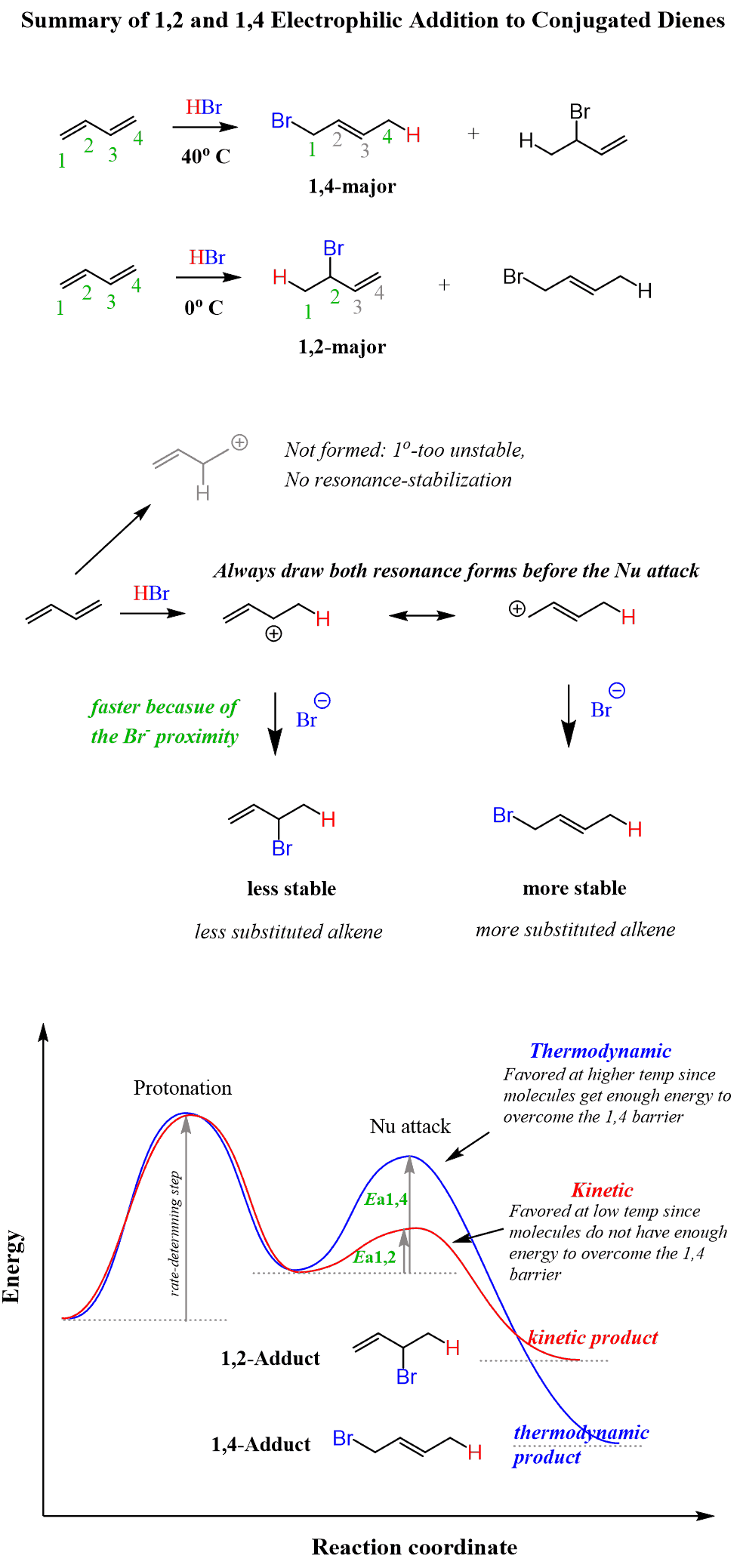
As a summary of this concept, remember that at equilibrium, the relative amounts of the products are determined by their stability, not by which one formed faster. Since the 1,4-addition product is more stable, it accumulates and becomes the major product.
In the next post, we will cover the addition reactions of conjugated dienes in more detail, including cases where the diene is symmetrical, the regioselectivity of the reaction, the stereochemistry of the products, as well as practice problems.
Check Also in Conjugated Systems:
- Resonance and Conjugated Dienes
- Allylic Carbocations
- 1,2 and 1,4 Electrophilic Addition to Dienes
- Molecular Orbitals and UV-Vis Spectroscopy
- Molecular Orbitals of 1,3-Butadiene
- 1,3,5-Hexatriene Pi Molecular Orbitals
- The Molecular Orbitals of Allylic Systems
- The Molecular Orbitals of Benzene
- Electrocyclic Reactions
- Claisen and Cope Rearrangements
- Sigmatropic Hydrogen Shifts
- Diels-Alder Reaction: Dienes and Dienophiles
- Predict the Products of the Diels-Alder Reaction with Practice Problems
- Diels-Alder Reactions of Cyclic Dienes and Dienophiles
- Endo and Exo Products of Diels-Alder Reaction with Practice Problems
- Regiochemistry of the Diels–Alder Reaction with Practice Problems
- The Retro Diels-Alder Reaction
- Molecular Orbitals in Diels-Alder and Other Cycloaddition Reactions
- Diels-Alder Reactions: EWG, EDG, and MO Interactions
- Diels-Alder Reaction Practice Problem
- Diels-Alder Reaction in Organic Synthesis Practice Problems