Saturated and unsaturated compounds
In this post, we will talk about saturated and unsaturated compounds, the degree of unsaturation (or Hydrogen Deficiency Index -HDI), and the different ways of calculating it. Let’s start with simple examples of saturated and unsaturated compounds.
Suppose you are asked to identify the following molecules as saturated or unsaturated:

How do you distinguish these two types?
Simply put, the compounds that only have single bonds are saturated and the ones with a π bond(s), which can be either a double or a triple bond(s) are classified as unsaturated.
So, looking at these, we can identify compounds A, D, E as saturated and B, F as unsaturated.
Compound C is a cycloalkane, and even though there are no π bonds in it, it is considered to have a degree of unsaturation. The reason for this is the lack of the two hydrogens that are expected for the corresponding alkane with six carbons.
Let’s go in order and talk about what is called the hydrogen deficiency index (HDI) or degrees of unsaturation first.
Degrees of unsaturation
What does the term saturated refer to? The molecule is saturated with what?
The degree of unsaturation or HDI is the capacity of the molecule to connect more hydrogen atoms. The capacity is reached when the molecule has the maximum possible number of hydrogen atoms per carbon (and other atoms).
For example, the following alkene and the ketone are unsaturated because it is possible to add hydrogen atoms to them without violating the octet rule and standard valencies of the elements, thanks to the presence of π bond(s):

Please note that these are not necessarily reactions with hydrogen gas. It is to demonstrate the principle.
The alkanes, on the other hand, are saturated because adding more hydrogens will result in exceeding the octet of the carbon atoms:
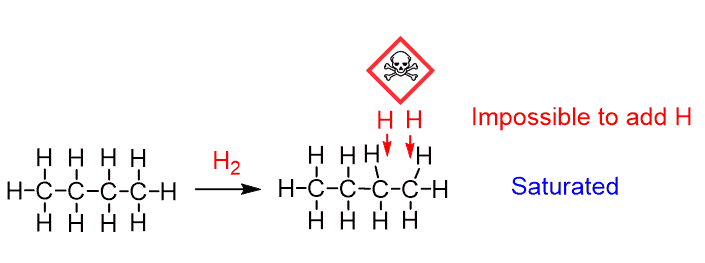
And this is how we classify compounds as saturated or unsaturated.
Now, not all the unsaturated compounds are identical. If more than one hydrogen molecule (two atoms) can be added to the molecule, then we need to specify the degree of unsaturation or HDI:
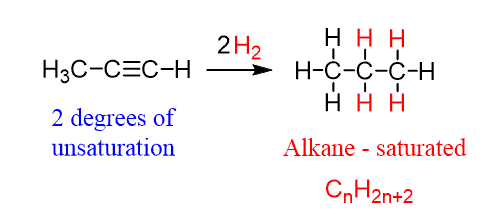
The general formula of alkanes (CnH2n+2) is used as the standard for determining and comparing different degrees of unsaturation, as alkanes are saturated and the simplest in composition among organic molecules.
Let’s draw the Lewis structure of propane and its corresponding alkene and alkyne and determine the degree of unsaturation (if any) for each of them.
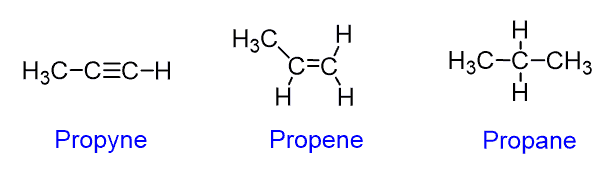
Going from propyne to propene takes the addition of one hydrogen molecule:
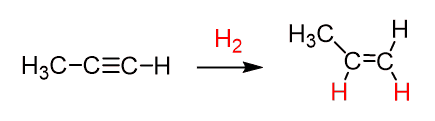
The propene is still an unsaturated compound capable of undergoing one more hydrogen addition:
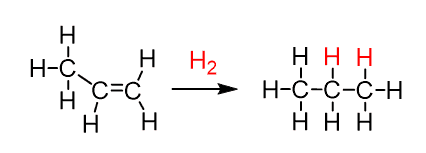
This converts propene to propane, which is a saturated compound as no more hydrogens can be added to the carbon atoms:
In total, it takes two hydrogens to get from propyne (an alkyne) to propane (an alkane) and because of this, the alkynes (with a single triple bond) are classified as hydrocarbons with two degrees of unsaturation.
The alkenes with a single double bond have one degree of unsaturation. This we can also see from the general formula of the hydrocarbons:
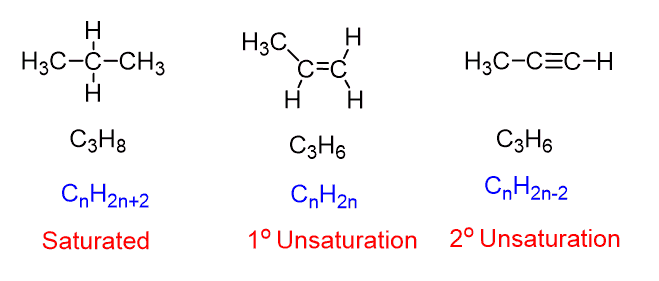
Alkenes have two hydrogens less than the alkanes, and alkynes have two hydrogens less than the alkenes. So every double bond brings one degree of unsaturatio,n and every triple bond brings two degrees of unsaturation.
It is worth mentioning that this is not related to carbon atoms only. An oxygen with a double bond brings one degree of unsaturation, a nitrogen with a triple bond brings two degrees of unsaturation, etc.

Rings and degrees of unsaturation
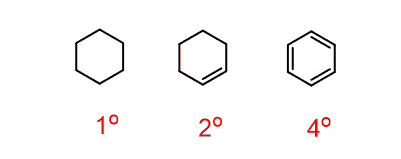
The general formula for cycloalkanes is CnH2n, and even though they only have single bonds, they are still lacking the two extra hydrogens that alkanes have (CnH2n+2). The reason for this is that none of the carbons get to turn into a CH3, like we have on the periphery of alkanes:
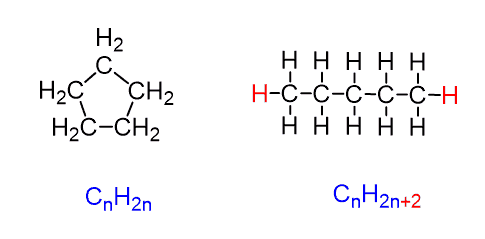
Therefore, remember, like for the double bond, every ring brings one degree of unsaturation.
If there is a ring with a double bond, then each counts separately as a degree of unsaturation:
How to calculate the degree of unsaturation?
In many cases, it is quite straightforward to determine the degree of unsaturation based on the number of multiple bonds and rings present in the molecule:
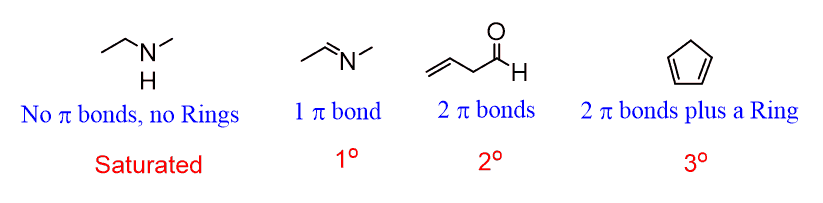
Let’s pay attention to one key factor here: For all of them, we had the Lewis structure provided to us, and we only needed to visually assess the unsaturation. However, it is important to have a formula to do this because often only the formula of the molecule is given and the structure is unknown.
For example, you may need to determine the HDI for C6H10ClNO2.
The structure is determined based on different techniques such as IR and NMR spectroscopies and having the degree of saturation in hand makes the process much easier.
There are two ways to determine the HDI:
- By assigning a role to different elements
- Using a formula. There are different formulas for this, but you can remember one and go with that.
Before determining the HDI of C6H10ClNO2, let’s talk about the effect of each heteroatom on the number of expected H’s separately, starting with halogens.
The effect of halogens on HDI
First, what does it mean to assess the role/effect of an element in the degree of unsaturation for the given compound?
The idea here is to compare how much the presence of each element (for example, a halogen, an oxygen, or a nitrogen) is changing the expected number of hydrogen atoms based on the number of carbons compared to the general formula of the corresponding alkane.
For example, for the formula C4H9Br, the expected number of hydrogens is 10 (C4H10, an alkane with the CnH2n+2 general formula). The number of hydrogen atoms is, however, 9 for 4 carbons, even though there is no unsaturation occurring because of the bromine.

What we see is that putting a halogen in place of a hydrogen did not create any degree of unsaturation and did not affect the number of expected hydrogen atoms. Therefore, when calculating the degree of unsaturation, simply replace the halogen with H and compare the resulting formula to the CnH2n+2 for that number of carbons. In this case, C4H9Br should have the same HDI as C4H10, and we know that C4H10 is, in fact, a saturated compound.
Example. What is the degree of unsaturation in the following compound: C5H9Cl?
Replacing the Cl with H gives us C5H10, which corresponds to the CnH2n general formula. CnH2n has two hydrogens less than its corresponding alkane (CnH2n+2), and this means the compound has one degree of unsaturation (HDI = 1). This compound has the same HDI as C5H10.
So, remember: for calculating the HDI, treat the halogen as if it were a hydrogen atom.
The effect of oxygen on HDI
To determine the effect of oxygen, let’s compare the HDI of butane and the diethyl ether, where the oxygen is placed in between the two ethyl groups:

What we see is that oxygen has no effect on the expected number of hydrogen atoms per carbon. The molecule still has 10 hydrogens for 4 carbons, which corresponds to the general formula of alkanes, CnH2n+2.
So, whenever calculating the HDI for a molecule containing an oxygen atom(s), simply ignore it.
As an example, the degree of unsaturation for C7H14O2 is the same as C7H14, which corresponds to the CnH2n general formula a with one degree of unsaturation.
The Effect of Nitrogen on HDI
Comparing the structures of the following alkane and the amine, we can see that nitrogen is changing the number of expected hydrogen atoms.
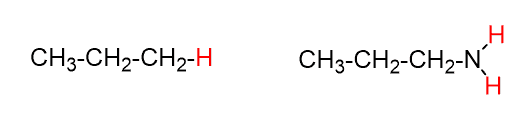
The nitrogen brought an extra H, and it is now 9 instead of 8 hydrogens for three carbons. Therefore, when there is a nitrogen atom present in the molecular formula, we must subtract one hydrogen atom from the molecular formula. This means that C3H9N should have the same HDI as C3H8.
As an example: The HDI for compounds with molecular formula C3H5N is the same as for C3H4, which belongs to the general formula of alkynes (CnH2n-2), which is four hydrogens less than the corresponding alkane; therefore, the HDI here is 2.
Now that we have covered the effect of N, O, and halogens on the HDI, let’s determine the degree of unsaturation for C6H10ClNO2:
- Replace the Cl with an H. We get C6H11NO2
- Ignore the Oxygens – C6H11N
- Subtract one H for the N – C6H10
This corresponds to the CnH2n-2 formula, which means the molecule has a 2-degree unsaturation. And this is the structure of the molecule that I had in mind when writing this example:

It has 2 π bonds, thus the HDI = 2.
Of course, this is not the only structure that would work for this molecular formula. Any constitutional isomer is possible.
Calculating HDI by using a formula
You can also calculate the HDI by using the following formula:
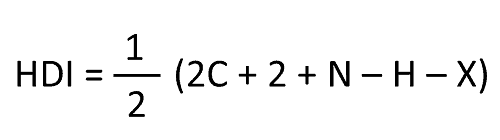
For the previous example, it would be:
1/2 (2×6 + 2 + 1 – 10 -1) = 2
Check this 60-question, Multiple-Choice Quiz with a 2-hour Video Solution covering Lewis Structures, Resonance structures, Localized and Delocalized Lone Pairs, Bond-line structures, Functional Groups, Formal Charges, Curved Arrows, Constitutional Isomers, and Hydrogen Deficiency Index.