
Organolithiums are extremely good nucleophiles and strong bases, and it should not be a surprise that they readily react with epoxides, which are highly strained electrophiles. The nucleophilic attack of the organolithium opens the epoxide ring, forming an alkoxide ion, which, upon protonation, gives the final product alcohol:
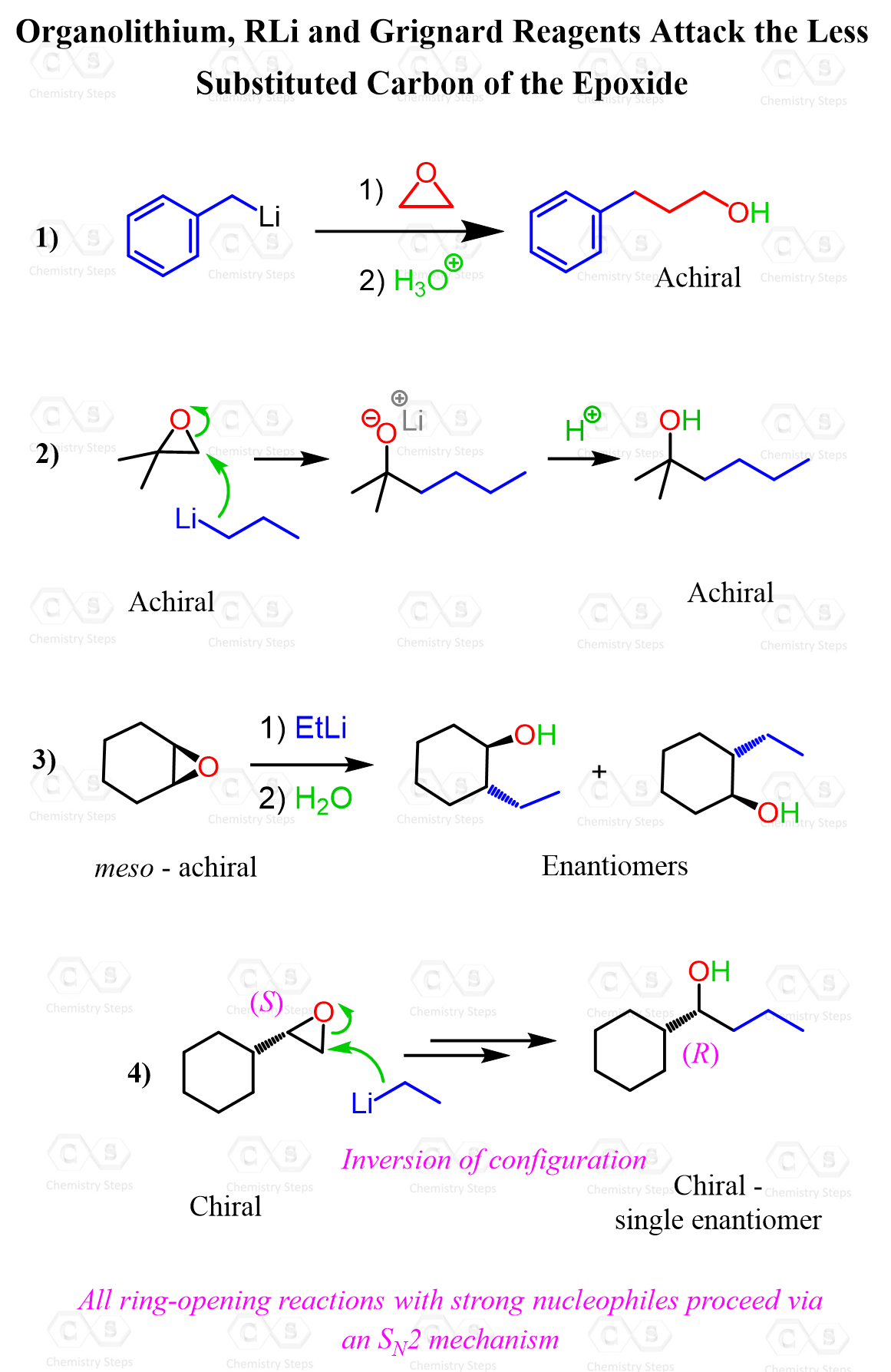
Notice in the last example, we have an unsymmetrical epoxide and the organolithium attacks its less substituted carbon. This is a common feature of epoxides when reacted with good nucleophiles, which defines the regiochemistry of the epoxide ring-opening reactions, including the ones with organolithium and Grignard reagents.
The Stereochemistry of Organolithium Reaction with Epoxides
The ring-opening of the epoxide by the RLi reagent occurs in an SN2 fashion, where the R does a backside attack on one of the carbons of the epoxide, breaking the C-O bond. This places the R and OH groups on opposite sides.
Now, the exact stereochemical outcome of the reaction depends on the structure of the epoxide.
RLi Reagents with Achiral Epoxides
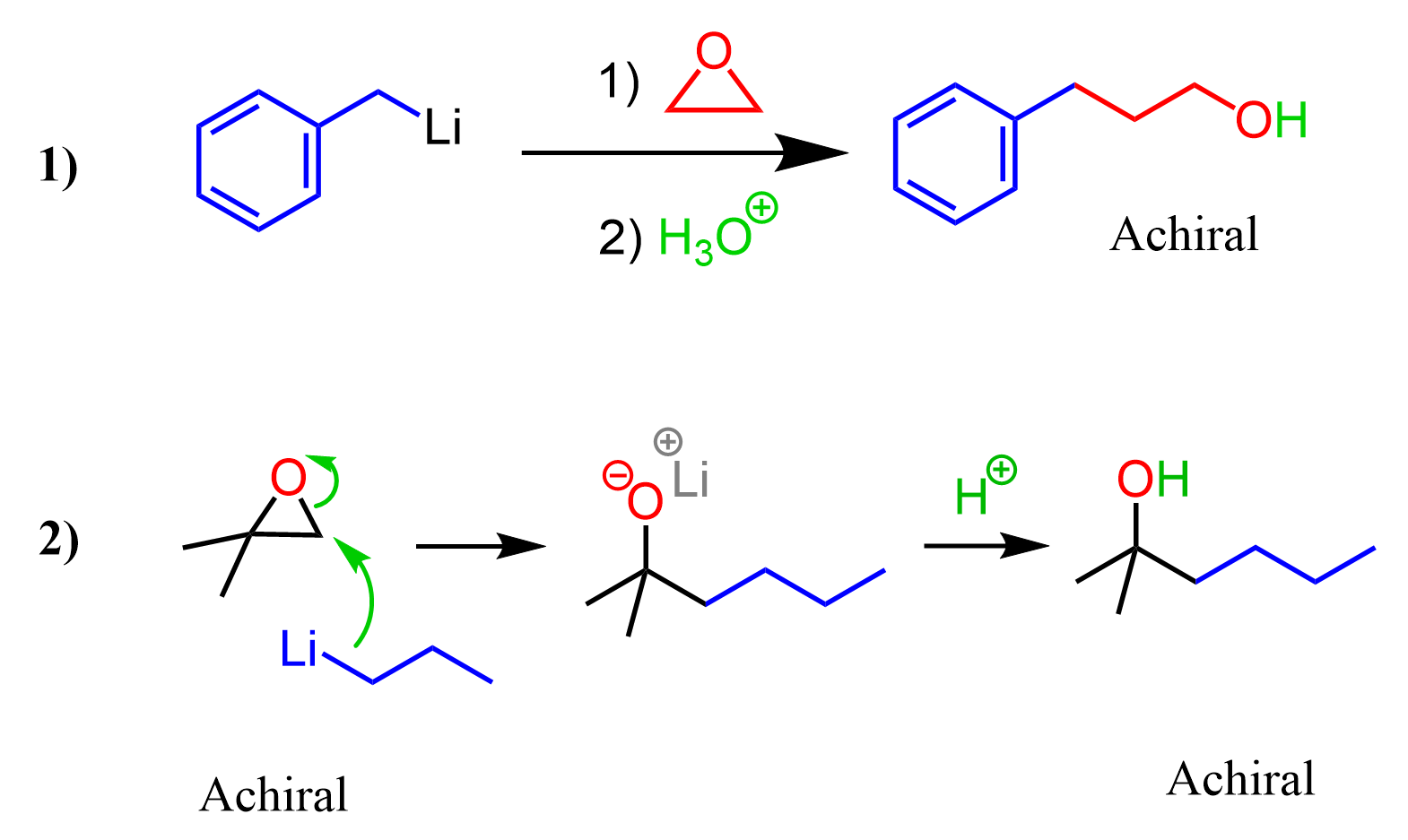
Achiral epoxides most often produce achiral products. For example, the achiral epoxides in the first two reactions above produce an achiral alcohol when reacted with an organolithium reagent:
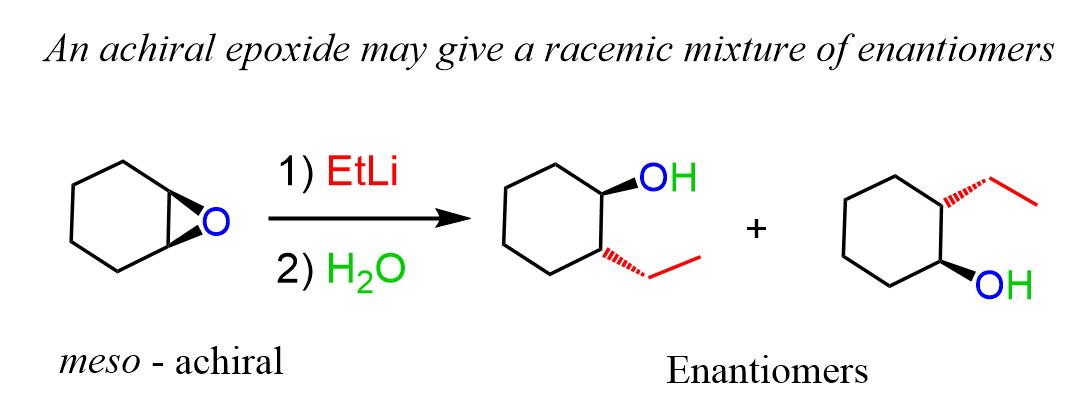
This is not always the case, though – the reaction of achiral epoxides with organolithiums can also produce a racemic mixture of enantiomers. For example, the cyclohexene epoxide is achiral as it is a meso compound. Remember, meso compounds are achiral because of the internal plane of symmetry; however, they do have chirality centers. When this epoxide is opened up with an organolithium or Grignard reagent, a racemic mixture of enantiomers is obtained because breaking any of the C-O bonds breaks the symmetry of the molecule as well:
RLi Reagents with Chiral Epoxides
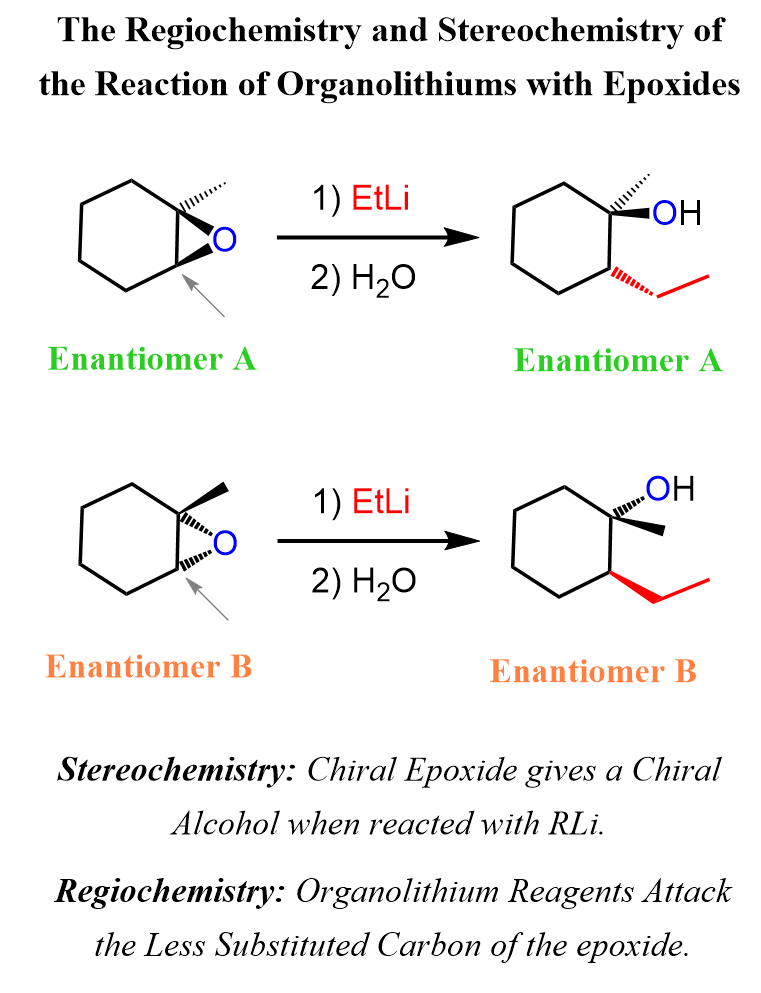
If the epoxide is chiral, each enantiomer gives the corresponding enantiomeric product, meaning that the reaction is stereospecific. To demonstrate this, let’s add a methyl group to one of the carbons of the cyclohexane oxide. We now have the specific enantiomer of the given epoxide, and if we react it without the presence of the other enantiomer, only one enantiomer of the alcohol is formed:
This is what I planned to cover for the reaction of organolithiums with epoxides. Check out this article on the summary of epoxide reactions, as well as the practice problems to master the topic.
At the end, I wanted to remind you that most of the reactions of organolithiums are identical to those of Grignard reagents. So, all the examples we have discussed here pertain to Grignard reagents as well. The organocopper, Gilman reagents (R2CuLi) are the least reactive among these, but they still react with epoxides in an identical manner to RLi and RMgX reagents.
One notable exception between the organolithium and Grignard reagents is the reactivity of organolithiums toward carboxylic acids due to their extremely powerful basic and nucleophilic nature.
Check Also
- Preparation of Epoxides
- Ring-Opening Reactions of Epoxides
- Reactions of Epoxides under Acidic and Basic Conditions
- Reactions of Epoxides Practice Problems
- The Grignard Reaction of Epoxides
- Naming Ethers
- The Williamson Ether Synthesis
- Reactions of Ethers-Ether Cleavage