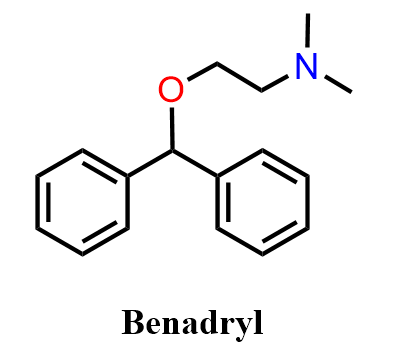
Synthesis of Benadryl

Diphenhydramine, best known under the brand name Benadryl, is a first-generation H₁ antihistamine widely used for the treatment of allergic conditions such as hay fever, urticaria, and other allergic reactions. It works by competitively blocking histamine H₁ receptors, thereby reducing symptoms like itching, swelling, and sneezing. Because diphenhydramine readily crosses the blood–brain barrier, it also exhibits significant sedative and anticholinergic effects, which is why it is commonly used as a sleep aid and for the prevention of motion sickness. Chemically, diphenhydramine is an ethanolamine derivative containing two aromatic rings connected to a tertiary amine, a structural motif typical of early antihistamines. While effective, its central nervous system effects, including drowsiness, impaired coordination, and dry mouth, limit its use compared to newer second-generation antihistamines. 


As with all examples in this section, this discussion is presented solely for educational purposes and is not intended to represent a practical or real-world method of preparation.


Practice

Below are shown two routes for preparing Benadryl from benzene. Identify the missing reagents and intermediates in the synthesis of Benadryl.

This content is for registered users only.

Click here to Register!

By joining Chemistry Steps, you will gain instant access to the answers and solutions for all the Practice Problems, including over 40 hours of problem-solving videos, Multiple-Choice Quizzes, Puzzles, Reaction Maps, and the powerful set of Organic Chemistry 1 and 2 Summary Study Guides.

Share Your Thoughts, Ask that Question!

Stuck? Need a Quick Guidance?

🔴 Our Live Board is Here! 🖥️✏️