
Transmetallation is the transfer of an organic group (ligand) from one metal to another during catalyzed cross-coupling reactions. It is one step in the catalytic cycle of palladium-catalyzed cross-coupling reactions, occurring between oxidative addition and reductive elimination.
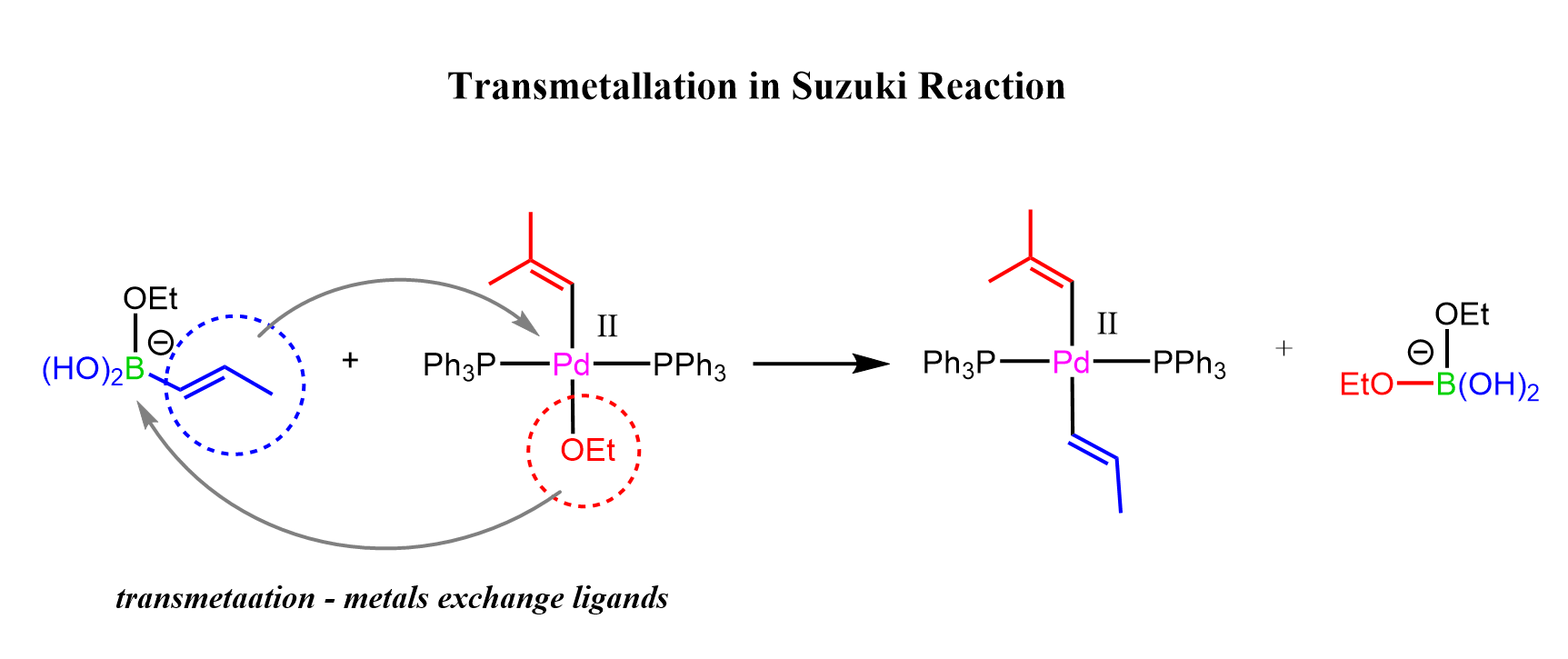
For example, this is a transmetallation step that occurs in the Suzuki reaction. The vinyl group attached to boron transfers to palladium, replacing the ethoxide ligand attached to the Pd center. This brings the two carbon fragments onto palladium and makes the coupling possible through the final reductive elimination step:
Let’s also look at the complete mechanism of this Suzuki reaction to understand where these ligands came from, how they are attached to B and Pd, and how they undergo reductive elimination to give the final product.
The Suzuki Coupling Mechanism
Like other cross-coupling reactions, the key role of Pd is to bring the two carbon fragments together and facilitate the formation of a new C–C bond. The reaction couples a vinyl or aryl halide with a vinyl, aryl, or alkyl boron reagent.
The catalytic cycle begins with oxidative addition, where Pd inserts into the C–X bond of the organic halide, forming a Pd(II) complex containing the organic fragment and the halide ligand.
Next, the boron reagent is activated by a base, forming a more reactive boronate species. During transmetalation, the organic group attached to boron is transferred to Pd, while the ligand on Pd is transferred to boron. This brings both carbon fragments onto the same Pd center:
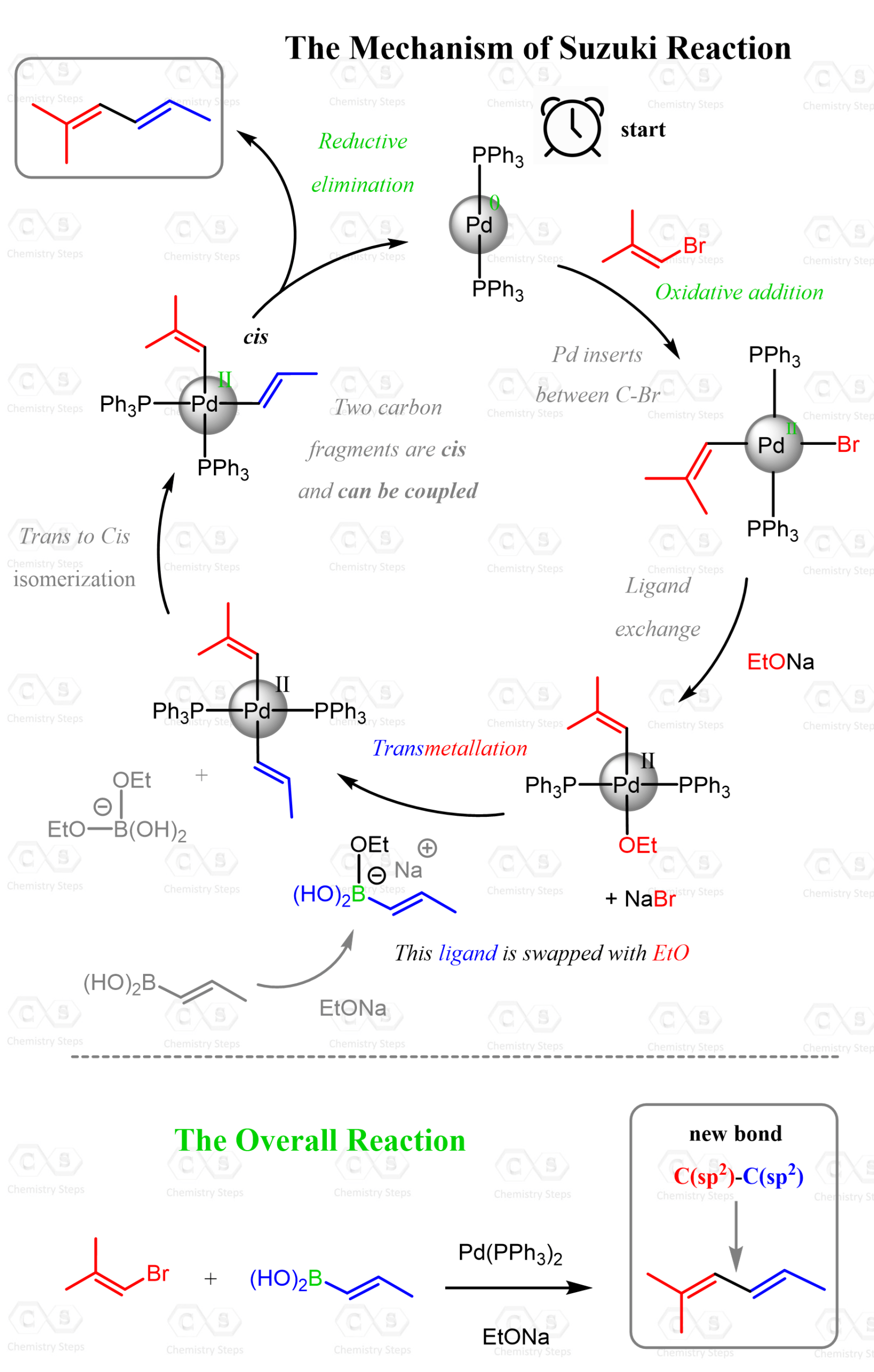
Finally, the two carbon groups undergo reductive elimination, forming the new C–C bond and regenerating the Pd(0) catalyst to complete the catalytic cycle. The Pd oxidation state decreases from +2 to 0 during this step because the two carbon ligands are removed from the metal center as they couple together.
Transmetalation in Other Cross-Coupling Reactions
The transmetallation step is not unique to the Suzuki coupling. Most cross-coupling reactions covered in organic chemistry, such as Stille, Negishi, and Sonogashira couplings, involve a transmetalation step:
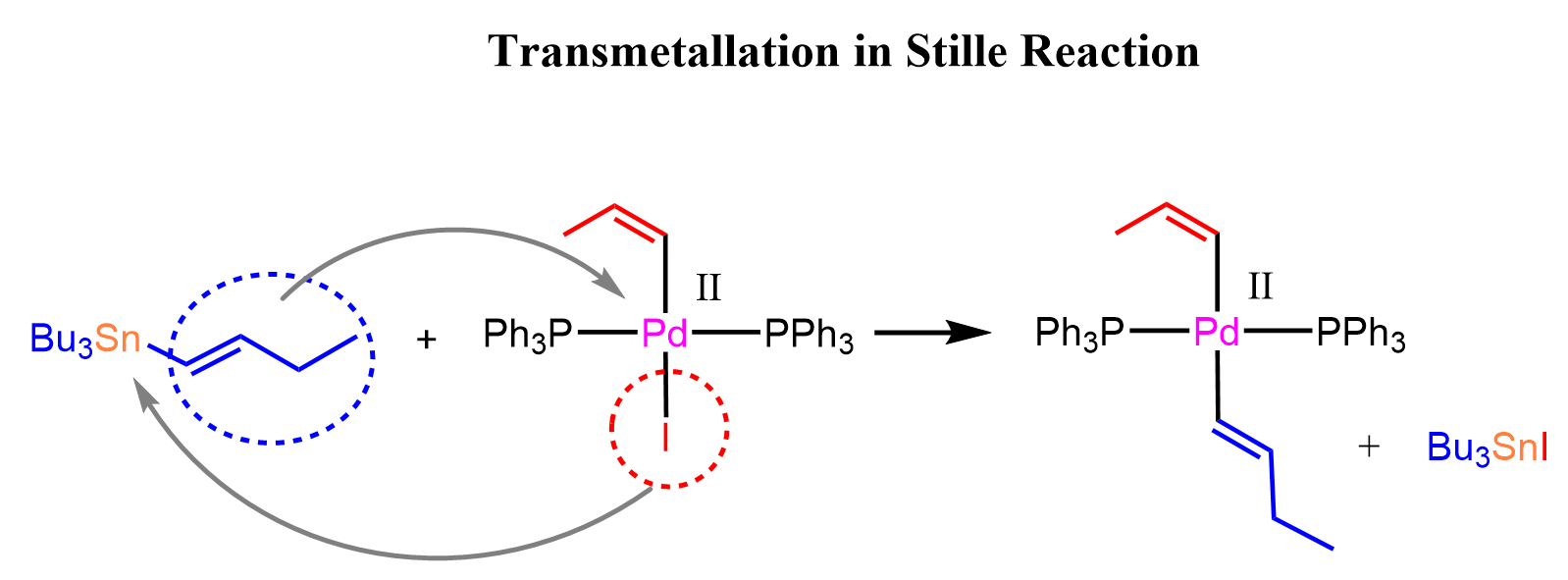
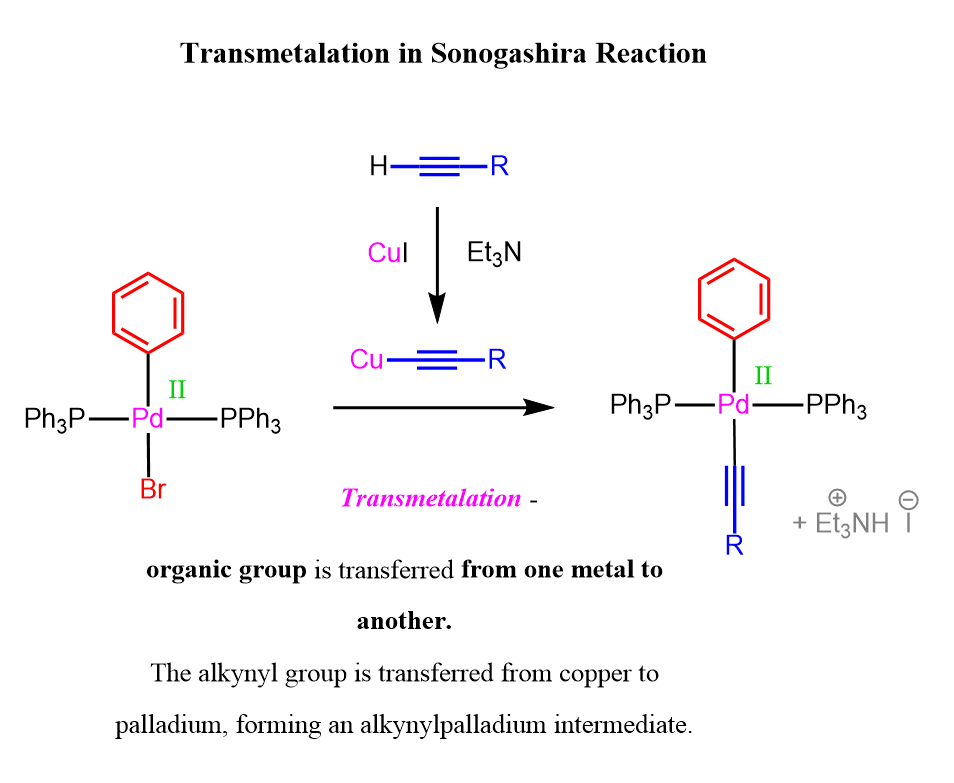
They differ in the metals and ligands involved in the transfer process, but the principle remains the same: transmetalation brings the two carbon fragments onto the main metal catalyst, typically Pd, so they can form a new C–C bond during the reductive elimination step.
Check Also
- Pd-Catalyzed Cross-Coupling Reactions
- Heck Reaction
- Suzuki Reaction
- Negishi Reaction
- Stille Coupling
- Sonogashira Coupling
- Alkene Metathesis