Formation and Reactions of Acetals
Acetals are organic compounds in which a carbon atom is bonded to two alkoxy groups (-OR). They don’t look much like a carbonyl compound, so why do we need to talk about them in the chapter on aldehydes … Read more
Nucleophilic Additions to the Carbonyl Group In this chapter on aldehydes and ketones, we begin to see a new type of mechanism originating from the polar nature of the C=O carbonyl bond. When we say “different,” that is mainly compared … Read more
This content is for registered users only. Click here to Register! By joining Chemistry Steps, you will gain instant access to the answers and solutions for all the Practice Problems, including over 40 hours of problem-solving videos, Multiple-Choice Quizzes, Puzzles, Reaction … Read more
The Beckmann rearrangement is a reaction in which a ketone is first converted to an oxime, which, under acidic or Lewis acidic conditions, rearranges into an amide. This reaction is closely related to the Hofmann, Schmidt, and Curtius rearrangements, as … Read more
Baeyer-Villiger Oxidation The Baeyer-Villiger oxidation is a rearrangement reaction that converts ketones to esters using peroxycarboxylic acids, such as meta-chloroperoxybenzoic acid (mCPBA). The Baeyer–Villiger oxidation can also convert aldehydes into carboxylic acids, but let’s be honest, including that as a key use … Read more
Aldehydes and ketones are carbonyl compounds, and the carbon here is in a relatively high oxidation state: Notice that the oxidation state of the carbon decreases with the number of hydrogens connected to it. On the contrary, the … Read more
Let’s discuss an important and perhaps the most common way of converting aldehydes and ketones to amines, known as reductive amination. Before going into the details of reductive amination, let’s recall that amines are not formed by “simply” reacting aldehydes … Read more
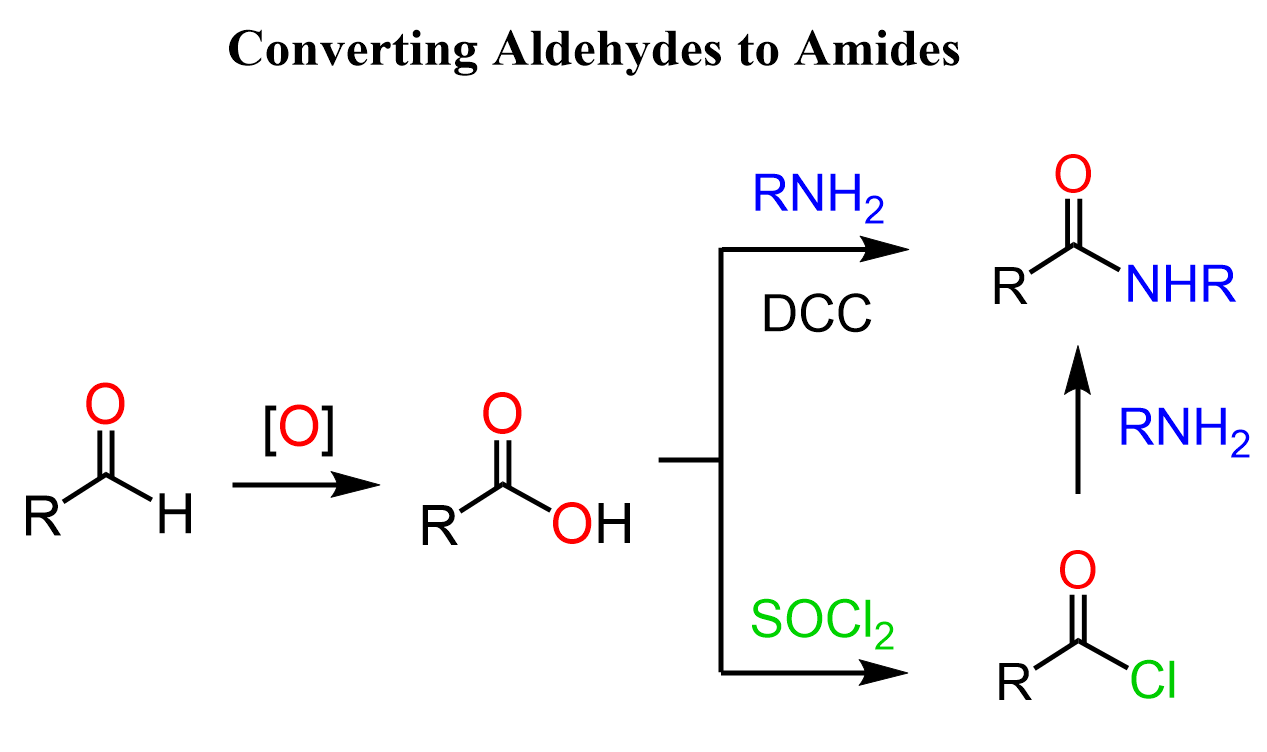
Amides are derivatives of carboxylic acids, therefore, one strategy to convert aldehydes to amides is by first oxidizing them to carboxylic acids. Once we have the carboxylic acid, we can subject it to condensation with amines using a coupling agent … Read more
Let’s discuss a few ways of converting ketones to amides, starting with the Beckmann rearrangement. It is not the ketone that undergoes a rearrangement but rather the intermediate oxime: Oximes are prepared from the ketone under acidic conditions, … Read more