Amines to Alcohols
We have seen that alcohols can be converted to amines by converting the OH into a good leaving group and reacting the substrate with an amine: The reverse process is more challenging because NH2 is even a worse … Read more
The only way of mastering any topic in Organic Chemistry is doing lots of practice problems. And I know, seeing my students, that starting to work on a practice problem may be the hardest part as you don’t know where to start. It is difficult to visualize what where the double bond would be moved if you follow the five curved arrows crammed in one step. Here is the trick:
We are always told to think before doing something. Fair enough. But let me tell you, it is also strangely enough, that in Organic Chemistry, it is often better to draw and then think about what you did (not in the lab though). It is much easier to have a structure in front of you and check for errors and improvements.
Do the first step, take the pencil and you will see that the ball gets rolling.
You have all these Organic Chemistry Practice Problems waiting to be solved!
We have seen that alcohols can be converted to amines by converting the OH into a good leaving group and reacting the substrate with an amine: The reverse process is more challenging because NH2 is even a worse … Read more
In the previous post, we discussed the methods for converting alkenes to alcohols via Markovnikov and anti-Markovnikov addition of water, the strategies to avoid possible rearrangements when the reactions go through carbocation rearrangements, as well as the indirect addition of … Read more
Alkyl halides can be converted to alcohols by reacting them with water or hydroxide ion. Recall that the hydroxide ion is a good nucleophile, and water is a poor nucleophile; therefore, the conversions occur via SN2 and SN1 mechanisms, respectively. … Read more
Epoxides undergo ring-opening reactions under both acidic and basic conditions. Let’s clarify that by “basic conditions” we refer to a greater class of epoxide ring-openings when they are reacted with good nucleophiles. This includes a number of them such as … Read more
The reactivity of epoxides is due to the high ring strain of three-membered rings. The reactions of epoxides lead to the ring opening, forming an alcohol with a variety of other functional groups in the product. We have seen, in … Read more
Ring Strain and Ring Expansion The title of today’s discussion contains two keywords: Ring Expansion and Rearrangement. So, what are those? A ring expansion is the transformation of a smaller ring to a larger ring. A rearrangement is a change … Read more
The SN1 mechanism is a unimolecular process, which means only the substrate participates in the rate-determining step of the reaction. The rate-determining step is the loss of the leaving group, which forms a carbocation. There are a few main features … Read more
Alkyl halides react with water by SN1 mechanism forming alcohols. Let’s put together some examples of these hydrolysis reactions of alkyl halides and address some important concepts such as the mechanisms, stereochemistry, the relationship of products, and different types of … Read more
Before talking about common exceptions in SN2 and SN1 reactions, let’s recall the main patterns we learned about them: 1) SN2 is favored for primary alkyl halides 2) SN1 is favored for tertiary alkyl halides 3) SN2 proceeds via inversion … Read more
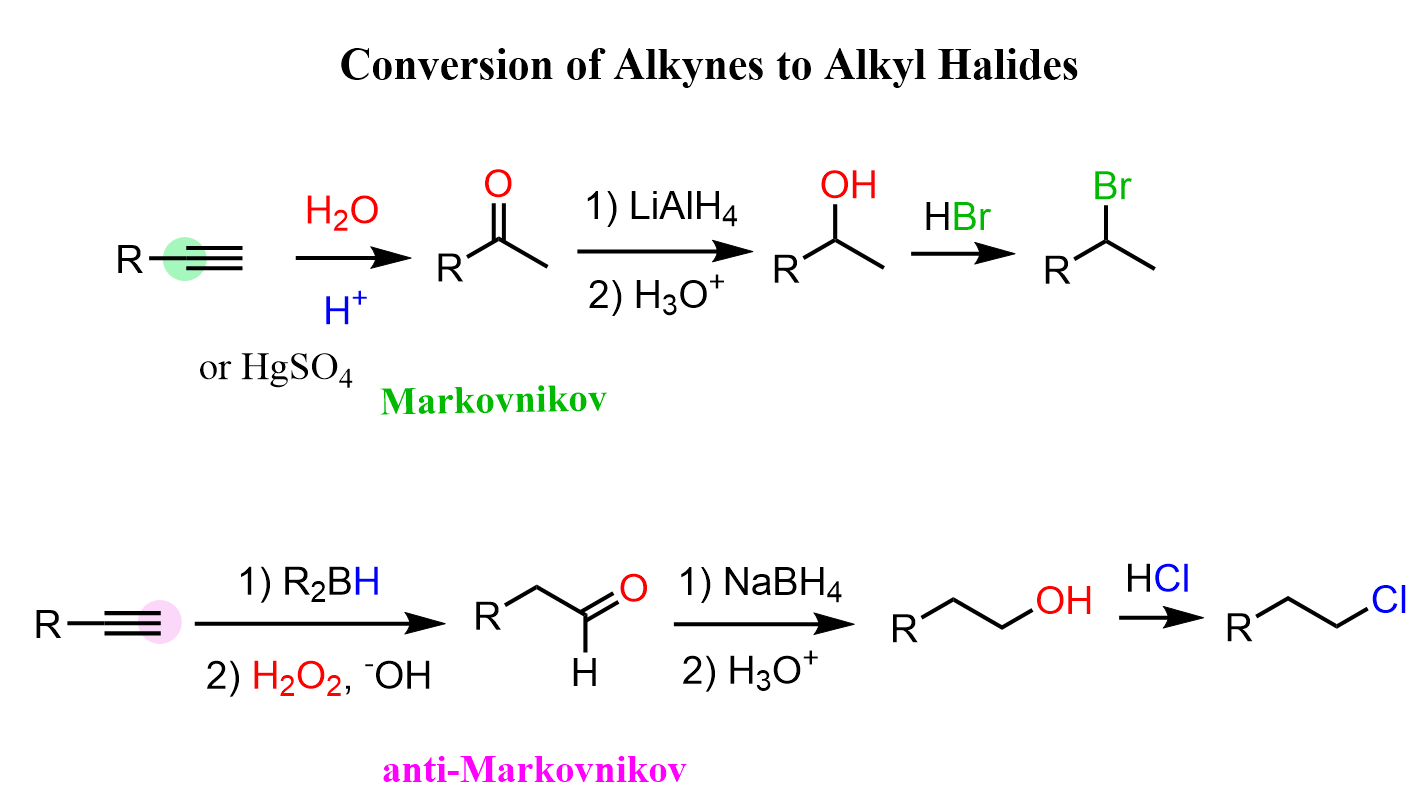
When alkynes are reacted with water, aldehydes and ketones are formed. While internal alkynes can only be converted to ketones by acid-catalyzed hydration or oxymercuration-demercuration, terminal alkynes can also be converted to aldehydes via anti-Markovnikov addition of hydroboration-oxidation: … Read more